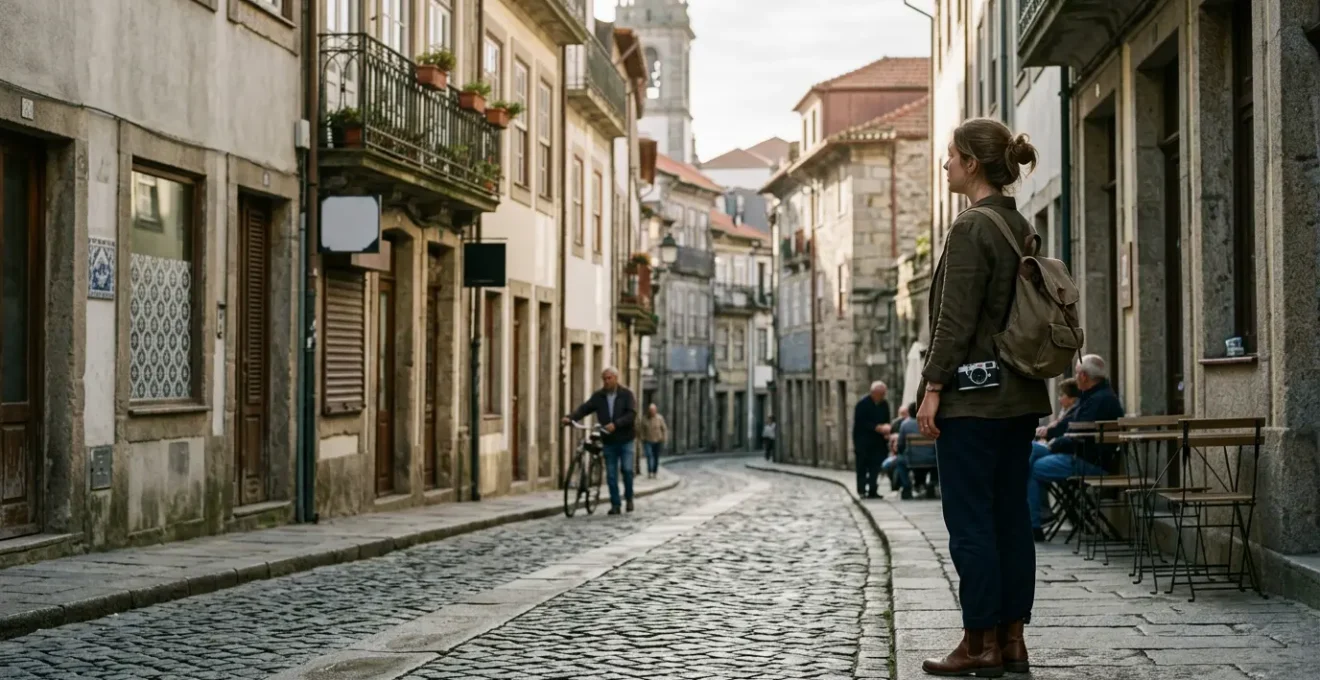
The greatest travel mistake is believing cultural understanding is found in the polished perfection of a capital city; true insight lies in the unscripted, everyday life of its ‘second cities’.
- Capitals are curated for tourists, presenting a simplified, often misleading, version of national identity.
- Second cities act as cultural laboratories, where the unwritten rules, rhythms, and authentic social dynamics of a country are on full display.
Recommendation: Ditch the landmark-chasing itinerary and instead adopt the mindset of a cultural anthropologist, using observation in second cities to decode the true story of a nation.
For the experienced traveler, the familiar rhythm of arriving in a capital city can feel both comforting and slightly hollow. You tick off the world-renowned museums, navigate the immaculate public transport, and photograph the grand monuments. Standard travel advice reinforces this path, suggesting you « eat local food » or « learn a few phrases. » While well-intentioned, these actions barely scratch the surface, often leading to interactions that are transactional rather than transformational. You’ve followed the script, but the genuine connection, the deep understanding of a place, remains elusive.
This approach mistakes the national stage for the backstage. Capitals are often internationalized hubs, their cultural edges smoothed down for global consumption. The « local life » you witness is frequently a performance for the benefit of tourism. But what if the key to unlocking a country’s soul wasn’t about seeing more, but about seeing differently? What if true immersion comes from stepping away from the spotlight and into the wings? This is the power of the « second city »—the regional powerhouses, the industrial hearts, the cultural counterpoints that operate by a more authentic set of rules.
This guide abandons the checklist model of tourism. Instead, it proposes a new framework: to travel as a cultural anthropologist. We will explore how to decode the unspoken « cultural scripts » that govern daily life, leverage solo travel for deep observation, and distinguish genuine experiences from staged performances. By focusing on the patterns and rhythms of life in these less-traveled urban centers, you can move beyond being a tourist and become a genuine student of the world.
This article provides a structured approach to cultivating this anthropological mindset. The following sections will guide you through the practical and psychological shifts required to turn your travels into a profound learning experience, from embracing culture shock to decoding local literature.
Summary: Why Visiting « Second Cities » Instead of Capitals Transforms Your Understanding of a Country?
- Why Culture Shock Is Actually Good for Your Mental Resilience?
- How to Plan a Culturally Immersive Trip Without Speaking the Local Language?
- Group Tours vs Solo Exploration: Which Offers Better Cultural Insight for Introverts?
- The « Authentic Village » Trap That Costs Tourists $200 for a Staged Show
- How to Cut Transport Costs by 30% to Afford Unique Local Workshops?
- Why « Intercultural Adaptability » Is the New Top Skill for Executives?
- How to Choose Literature from Cultures That Confront Your Own Values?
- How a 6-Month Professional Exchange Can Fast-Track Your Promotion?
Why Culture Shock Is Actually Good for Your Mental Resilience?
Culture shock is often framed as a negative travel symptom to be avoided. This perspective is a mistake. For the traveler seeking deep understanding, that initial jolt of disorientation—when you don’t know how to queue, order coffee, or interpret a simple gesture—is the most valuable signal you can receive. It’s a sign that you have successfully exited your own cultural bubble. This discomfort is not a failure; it is the friction necessary for growth. It is the very beginning of genuine learning.
From an anthropological viewpoint, this shock is the moment your brain’s autopilot, which relies on your native « cultural scripts, » has been disengaged. You are forced to switch from passive existence to active observation. Every mundane task becomes a puzzle to be solved, heightening your awareness and forcing you to notice details you would otherwise ignore. Why do people stand so close? Why is everything so quiet on the train? These are not trivialities; they are data points revealing underlying societal values about personal space, community, and social order.
Actively leaning into this feeling builds profound mental resilience. By repeatedly navigating ambiguous social situations and successfully decoding new rules, you are training your brain’s cognitive flexibility. You learn to become comfortable with not knowing, a powerful skill in an increasingly complex world. Second cities are perfect for this process. Unlike hyper-touristic capitals where locals may adjust for foreigners, a second city forces you to adapt to its rhythm, not the other way around. Embracing this challenge transforms a potentially stressful experience into a powerful mental workout, leaving you more adaptable and resilient long after you return home.
Therefore, the goal is not to avoid culture shock but to recognize it as the price of admission to a deeper level of understanding, a sign that your journey of discovery has truly begun.
How to Plan a Culturally Immersive Trip Without Speaking the Local Language?
The belief that you cannot have a deep cultural experience without speaking the language is a common but misguided barrier. While language is a powerful tool, its absence forces you to develop a far more primal and potent form of communication: sensory ethnography. You learn to listen with your eyes, to understand through observation, and to communicate through a universal language of gesture and intention. This non-verbal immersion can often reveal more about a culture’s unspoken rules than a stilted, translated conversation.
The key is to shift your focus from verbal exchange to behavioral analysis. Before even attempting a transaction in a local market, spend fifteen minutes at a nearby cafe. Watch. How do people greet the vendor? How is money exchanged? Is there a bargaining ritual? By observing these « behavioral proxies, » you absorb the local script without speaking a word. Your goal is to blend into the rhythm of the place, not to disrupt it with your foreignness. This quiet observation is a form of deep respect that locals often recognize and appreciate far more than a poorly pronounced « hello. »
This approach relies on a toolkit of non-verbal strategies and visual aids. A smile, a direct gaze, and an open posture can cross any linguistic divide. The following illustration captures a moment where connection transcends language, built purely on gesture and shared humanity in a bustling, authentic setting.
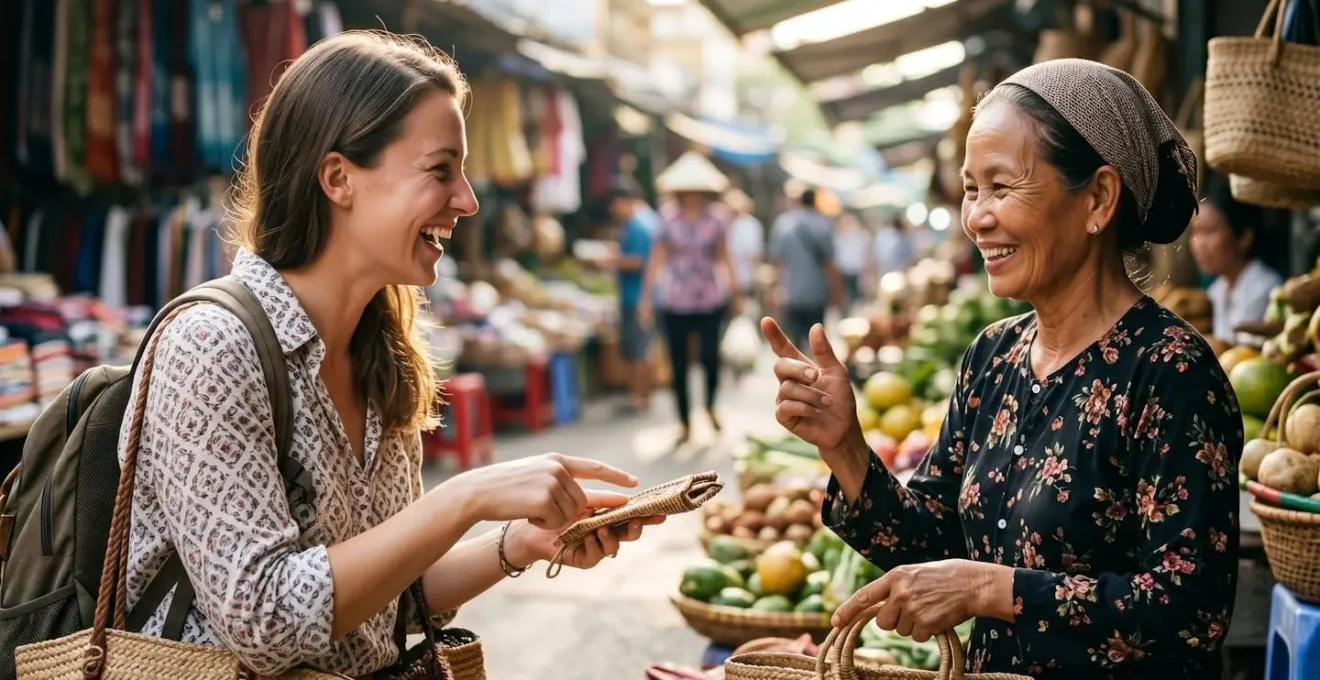
As the image suggests, human connection is not solely dependent on words. By using universal gestures and paying close attention to the context, the traveler becomes a participant, not just a spectator. To make this practical, arm yourself with visual tools: a photo of your hotel’s business card for taxi drivers, pictures of food allergies, and an offline map app are your best friends. These simple preparations transform a potential point of frustration into a seamless, silent dialogue.
Your Action Plan: Non-Verbal Communication Strategies
- Observe local behavioral patterns: Watch how locals order, pay, and interact in markets and cafes before attempting transactions yourself.
- Use contextual observation: Spend time watching the flow of daily routines in public spaces to understand unspoken cultural scripts.
- Leverage body language intentionally: Face people directly, nod to show understanding, use gestures combined with a smile to communicate basic needs.
- Carry visual aids: Business cards from your hotel, pictures of dietary restrictions, and a physical map eliminate language dependency.
- Download offline resources: Translation apps with offline capabilities, saved phrases, and downloadable maps for areas without connectivity.
Ultimately, traveling without a shared language is not a handicap; it is an opportunity to develop a heightened sense of awareness and to connect with the local culture on a fundamentally human level.
Group Tours vs Solo Exploration: Which Offers Better Cultural Insight for Introverts?
The stereotypical image of a solo traveler is one of extroverted adventure, easily striking up conversations with strangers. For an introvert, this can be daunting, making the structured environment of a group tour seem like a safer bet. However, this choice isn’t a simple binary of « lonely freedom » versus « structured community. » For the introverted traveler seeking deep cultural insight, the optimal path is often a hybrid approach, and the key lies in understanding the psychology of introversion itself.
As research highlights, the core trait is not shyness, but a need to manage stimulation. As noted in a study on personality and environmental preference published by Frontiers in Psychology, introversion is linked to a preference for predictable, low-stimulation environments. This doesn’t mean introverts want to stay in their hotel rooms. It means they thrive when they can control their social energy, observing from the quiet of a « Third Place » like a cafe or a park bench. Solo travel is uniquely suited for this, allowing for long periods of quiet, anthropological observation punctuated by intentional, short-burst interactions—a far more effective way to decode cultural scripts than the constant social noise of a group tour.
However, the fear of isolation is real. The solution isn’t to abandon structure entirely but to seek flexible tour options. Industry reports show that this is a growing market, with data indicating that 52% of solo travelers show interest in escorted tours that specifically balance group activities with ample scheduled alone time. These « solo-in-a-group » tours or day-long workshops provide the social scaffolding for key experiences (like a cooking class or a guided historical walk) while leaving mornings and evenings free for the solitary exploration and recharging that introverts need.
Introversion correlates with stronger preferences for predictable, lower-stimulation environments, which has direct implications for destination choice.
– Frontiers in Psychology research, Research on personality and environmental preference
For the introvert, the perfect strategy is to use solo travel as the default for observation and use small, specialized group activities as strategic tools for access and low-pressure social connection.
The « Authentic Village » Trap That Costs Tourists $200 for a Staged Show
One of the most pervasive and costly pitfalls for the well-intentioned traveler is the « authentic village » tour. Marketed as a window into timeless tradition, these experiences often present a hyper-polished, sanitized, and ultimately fictional version of local life. You pay a premium to see locals in traditional dress perform scripted dances and craft souvenirs on demand. While visually appealing, this is not cultural immersion; it is cultural theater, designed to meet a tourist’s preconceived notions of « authenticity. »
The existence of these traps isn’t born from malice but from a simple economic reality: tourists are willing to pay for easily digestible cultural narratives. A real village is complex, messy, and may not align with romanticized ideals. A staged village, however, delivers a perfect, photogenic experience every time. The danger for the traveler is twofold. First, you leave with a completely skewed understanding of the culture. Second, you miss the opportunity for genuine connection, which is often found in the less-polished, everyday interactions of a real town.
So, how does the anthropological traveler avoid this trap? By looking for breaks in the « cultural script. » A genuine community has an internal logic and rhythm that a staged one lacks. The key is to observe the context, not just the performance. Are the « artisans » only working when the tour bus arrives? Are the children’s smiles a little too practiced? Is every single person in traditional attire, with no signs of modern life like a cell phone or a pair of sneakers? These are red flags indicating a performance, not a reality. True culture is lived, not performed on a schedule.
Your Checklist for Spotting Staged « Authenticity »
- Points of Contact: Is the experience only accessible through a single tour operator, or can you visit independently? Exclusivity is often a warning sign.
- Economic Activity: Does the village’s economy seem to revolve entirely around tourism, or are there other visible forms of livelihood (farming, local businesses)?
- Social Dynamics: Observe interactions between the locals themselves. Do they seem natural and spontaneous, or are they oriented solely towards the tourists?
- Material Culture: Is everything pristine and « traditional, » or is there a mix of old and new, as in any living community? Look for the natural wear and tear of daily life.
- Spontaneity vs. Script: Does the experience feel like it would continue exactly the same way if your tour group wasn’t there? If not, it’s likely a script.
The goal is to seek out places where life happens for its own sake, not for an audience. A truly authentic experience might be as simple as watching a game of cards in a public square or seeing how a family shops in a neighborhood grocery store—mundane, unscripted, and infinitely more revealing.
How to Cut Transport Costs by 30% to Afford Unique Local Workshops?
For the traveler focused on immersion, budget allocation is a strategic choice. Every dollar spent on a generic taxi ride or an overpriced tourist shuttle is a dollar not spent on a truly unique experience, like a local pottery workshop, a regional cooking class, or a session with a traditional musician. The goal of cutting transport costs isn’t merely to be frugal; it’s to consciously reallocate funds from the « getting there » to the « being there, » transforming your travel budget from a logistical expense into an investment in cultural capital.
The most significant savings and deepest immersion come from embracing a city’s public transport system. This is a primary « Third Place » where you can observe a cross-section of society. Watching how people interact, what they read, and how they navigate their daily commute provides a wealth of anthropological data. Instead of isolated in a taxi, you become a temporary part of the city’s circulatory system. A multi-day transit pass is almost always the first and best investment you can make, often reducing per-trip costs by more than 30% compared to single fares or private transport.
Beyond the metro or bus, consider the transportation methods used by locals for inter-city travel in second-tier regions. Often, this means regional trains or shared minibuses instead of expensive high-speed rails or domestic flights that cater to tourists and business travelers. While potentially slower, these options are not only cheaper but also offer a window into the country’s connective tissue. You’ll pass through smaller towns, share space with everyday people, and witness the landscape unfold at a more human pace. This strategic choice saves money that can be directly channeled into a memorable, hands-on workshop that offers skills and memories a taxi ride never will.
By treating transportation as an opportunity for observation rather than just a means to an end, you simultaneously save money and enrich your travel experience, freeing up resources for the moments that truly matter.
Why « Intercultural Adaptability » Is the New Top Skill for Executives?
In the corporate world, the most sought-after executives are no longer just those with technical expertise, but those who possess a high degree of intercultural adaptability. This is the ability to read subtle social cues, understand different communication styles, and modify one’s own behavior to build trust and work effectively across cultural divides. While business schools offer courses on this, there is no training more effective or visceral than the real-world experience of immersing oneself in a second city and learning to navigate its unspoken rules.
A capital city often presents a globalized business culture. Meetings in Paris, London, or Tokyo can feel remarkably similar. But negotiating a deal in a second city like Lyon, Manchester, or Osaka requires a different level of acuity. Here, local customs, communication patterns, and decision-making processes are less diluted. An executive who has spent time learning to interpret the « behavioral proxies » of a foreign culture on their own time—understanding why a « yes » might mean « I hear you » rather than « I agree »—has a significant competitive advantage. They have moved beyond textbook knowledge to embodied understanding.
This skill is increasingly seen as a core component of leadership. A report on global leadership trends emphasizes that future leaders must be « cultural bridge-builders. » The experience of traveling in second cities is a direct-line training for this. It teaches you to be a better observer, to listen more than you speak, to be patient with ambiguity, and to find common ground in unexpected places. These are not soft skills; they are the essential strategic tools for anyone operating in a globalized economy. The ability to correctly interpret a moment of silence in a meeting or understand the importance of relationship-building before talking business is what separates a successful international executive from a frustrated one.
Companies are beginning to recognize that an employee with a passport full of second-city stamps may bring more value to the global team than one with a perfect GPA from a top-tier business school.
Key Takeaways
- True cultural insight is found not in landmarks, but in observing the unwritten ‘cultural scripts’ of everyday life.
- Second cities, less polished for tourism, offer a more authentic laboratory for this kind of anthropological observation.
- The goal of immersive travel is to develop ‘intercultural adaptability’—a skill that enhances both personal resilience and professional value.
How to Choose Literature from Cultures That Confront Your Own Values?
To truly understand a country, you must engage with its internal conversations, its debates, and its anxieties. One ofs the most powerful ways to access this inner world is through its literature. However, simply picking up the most famous, internationally acclaimed novel can be misleading. These « national treasures » are often chosen because they present a palatable, heroic, or historically significant image of the nation. To go deeper, one must seek out literature that confronts, complicates, and even contradicts your own values and the country’s official narrative.
The first step is to look beyond the capital’s literary elite. Seek out authors from the country’s second cities and regions. These writers often explore themes of marginalization, regional identity, and tension with the central power structure that are invisible in the « great national novels. » Their work provides a crucial counter-narrative, revealing the fault lines and complexities that make a culture rich and dynamic. Instead of a book that confirms a nation’s greatness, look for one that questions it.
The goal is not to judge, but to understand. When a book from another culture presents a perspective on family, honor, or individuality that feels alien or even morally questionable to you, this is a moment of profound learning. Resist the urge to dismiss it. Instead, ask: what social structure, historical context, or philosophical tradition makes this viewpoint logical within its own framework? Engaging with literature in this way is a form of intellectual culture shock. It’s a challenging exercise in empathy and cognitive flexibility, forcing you to hold multiple, often contradictory, worldviews in your mind at once. This is the very essence of expanding your own perspective, and it is a souvenir that will last far longer than any physical object you could bring home.
Choosing literature that makes you uncomfortable is choosing to grow, and it is one of the most powerful and intimate ways to connect with the soul of a place.
How a 6-Month Professional Exchange Can Fast-Track Your Promotion?
A short business trip to a foreign capital is a snapshot; a six-month professional exchange in a second city is a feature film. It’s the difference between seeing the highlights and understanding the plot. For an ambitious professional, this extended immersion is not a career detour but a strategic accelerator, providing a depth of intercultural expertise that is impossible to gain through any other means and can directly fast-track a promotion upon return.
During a long-term exchange, you move beyond the surface-level challenges of travel and into the complex web of workplace culture. You learn the real meaning behind management styles, the unwritten rules of team meetings, and the subtle art of giving and receiving feedback in a different cultural context. You are no longer just an observer of « cultural scripts »; you are a participant, and your professional success depends on your ability to adapt. This sustained, high-stakes environment is the ultimate crucible for forging intercultural adaptability.
The value you bring back is immense. You return not just with knowledge of a foreign market, but with a new operating system for dealing with ambiguity and human dynamics. You become the go-to person for mediating with international teams, the one who understands why the German office needs more data and the Japanese office needs more consensus-building. You have demonstrated resilience, adaptability, and an ability to create value in an unfamiliar environment—the very definition of leadership potential. In a competitive corporate ladder, this demonstrated mastery of global business nuance is a rare and highly promotable asset.
This experience is a powerful narrative for your career, signaling to leadership that you are not just a manager for today, but a global leader for tomorrow. To transform your career, seek out the opportunities that force you to adapt, and you will find your path to leadership significantly shortened.