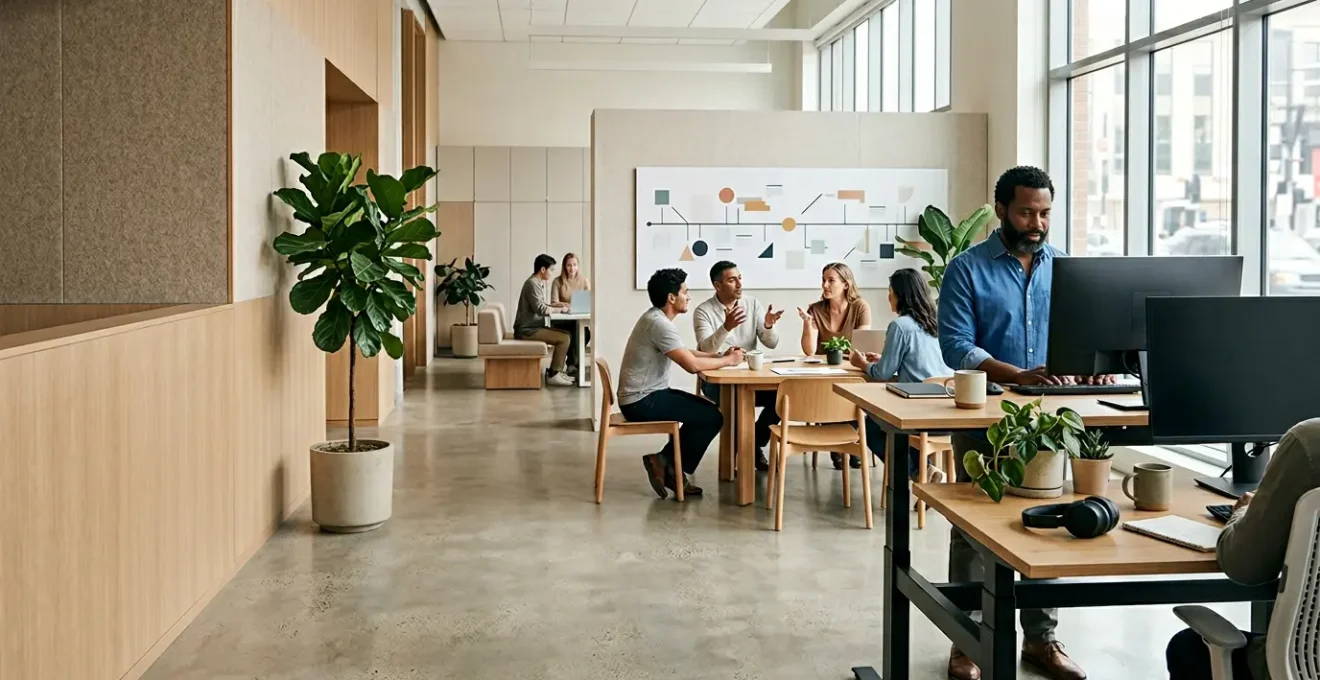
Most efforts to support neurodivergent employees fail because they try to patch a system that is fundamentally broken.
- Genuine psychological safety isn’t about individual accommodations; it’s about dismantling the “neurotypical-by-default” operating system of your workplace.
- Processes like hiring for « culture fit » and unstructured meetings create systemic friction that excludes valuable talent.
Recommendation: Shift your focus from fixing individuals to redesigning your core processes—hiring, meetings, and promotions—with explicit communication and cognitive flexibility at their center.
For years, leaders have been told that building an inclusive workplace for neurodivergent talent—individuals with ADHD, autism, dyslexia, and other variations in brain function—is a matter of empathy and accommodation. We’ve been encouraged to « be more understanding » and to offer noise-canceling headphones. While well-intentioned, this approach fundamentally misses the point. It places the burden of adaptation on the neurodivergent employee and treats their needs as an exception to the rule, rather than a vital perspective for improving the entire system.
The result is a persistent environment of systemic friction and high cognitive load, where talented individuals spend more energy navigating unspoken social rules and inefficient processes than they do on their actual work. This is a quiet crisis happening in plain sight. We see companies championing diversity publicly while their internal structures quietly filter out anyone who doesn’t fit a narrow, neurotypical mold. The issue isn’t a lack of talent; it’s a lack of a genuinely safe and accessible environment for that talent to thrive.
But what if the solution wasn’t about adding more patches, but about redesigning the workplace’s core operating system? The true path to psychological safety lies in moving away from individual, reactive accommodations and toward proactive, structural inclusion. This means examining and rebuilding the foundational processes—from how we hire and run meetings to how we mentor and promote—to be explicit, transparent, and cognitively accessible by default. This article will guide you through the structural changes that dismantle the « neurotypical-by-default » workplace and build a foundation of genuine psychological safety where everyone, not just neurodivergent team members, can excel.
In this guide, we will deconstruct the hidden barriers within common workplace practices and provide a structural framework for building a truly inclusive culture. The following sections outline a clear path from identifying systemic bias to implementing strategies that foster genuine belonging and high performance.
Summary: From Bias to Belonging: A Structural Guide to Neuroinclusion
- Why « Culture Fit » Is Often Just Code for Hiring People Like You?
- How to Structure Meetings So Introverts and Non-Native Speakers Are Heard?
- Mentorship vs Sponsorship: Which Actually Moves the Needle for Minority Promotion?
- The « Rainbow Washing » Mistake That Destroys Employee Trust in June
- How to Make Your Virtual Workspace Accessible for Visually Impaired Staff?
- Why Video Calls Cannot Trigger the Same Oxytocin Release as a Handshake?
- The Corporate Culture Mismatch That Kills 50% of Strategic Alliances
- How to Structure a B2B Partnership That Doubles Your Reach for Free?
Why « Culture Fit » Is Often Just Code for Hiring People Like You?
The concept of « culture fit » is one of the most pervasive and damaging barriers in modern recruiting. Presented as a way to ensure team cohesion, it often functions as a justification for unconscious bias. For neurodivergent candidates, who may communicate or interact differently from the neurotypical majority, this concept is a significant hurdle. In fact, research reveals that 76% of neurodivergent job seekers feel that traditional recruitment methods put them at a disadvantage. The interview process, heavily reliant on interpreting subtle social cues and demonstrating a specific style of confidence, becomes a performance of conformity rather than a showcase of skills.
Hiring managers often mistake interpersonal comfort for professional competence. When an interviewer says they « clicked » with a candidate, they are frequently referring to shared backgrounds or communication styles, not an objective measure of the candidate’s ability to perform the job. This bias is not just theoretical; it’s a well-documented phenomenon that perpetuates homogeneity.
Case Study: The « Chemistry » Bias in Elite Firms
Research by Professor Lauren Rivera at Northwestern University provided a stark look into this reality. After studying 120 hiring decision-makers, she found that evaluators consistently prioritized candidates with whom they felt personal « chemistry. » This feeling was almost always derived from shared experiences, such as attending the same university, playing the same sports, or even vacationing in the same spots. Highly skilled candidates who did not share these superficial commonalities were often rejected for not being a good « fit, » demonstrating how this metric actively filters out diversity of thought and experience.
To dismantle this barrier, organizations must shift from assessing « culture fit » to evaluating « value alignment » and « culture contribution. » This involves using structured interviews with standardized questions, focusing on skills-based assessments, and training hiring managers to recognize and challenge their own affinity bias. The goal is not to hire people you’d want to have a beer with, but to hire people who possess the skills and diverse perspectives needed to drive the organization forward.
How to Structure Meetings So Introverts and Non-Native Speakers Are Heard?
Meetings are the heartbeat of corporate life, but for many neurodivergent individuals, they are a primary source of cognitive load and anxiety. The standard meeting format—a free-flowing, unstructured discussion dominated by the fastest thinkers and loudest voices—is fundamentally exclusive. It inherently favors a specific neurotype: one that can process information verbally in real-time, navigate complex social dynamics, and compete for airtime. This « neurotypical-by-default » design effectively silences introverts, non-native speakers, and anyone who needs time to process information before contributing.
This creates a significant loss of potential innovation and insight. Great ideas are lost not because they don’t exist, but because the system provides no viable channel for them to be heard. True inclusion in meetings requires moving away from this chaotic model and implementing explicit communication protocols. The goal is to lower the barrier to participation for everyone by making the « rules of engagement » clear and fair.
This involves providing multiple modes for contribution. Some individuals excel at verbal debate, while others formulate their best ideas through writing or quiet reflection. A structurally inclusive meeting honors these different processing styles. The illustration below visualizes a more thoughtful approach, where team members can engage through various channels, fostering a calmer, more productive environment.

As you can see, an inclusive meeting isn’t about forcing everyone to speak up; it’s about creating a system where everyone’s input can be captured, regardless of their communication style. This might include sending out an agenda with clear questions beforehand, using a shared digital document for real-time notes and questions, or incorporating designated « silent thinking time » into the discussion. By redesigning the structure, you stop penalizing different thinking styles and start harnessing their collective power.
Mentorship vs Sponsorship: Which Actually Moves the Needle for Minority Promotion?
In the conversation around career progression for underrepresented groups, including neurodivergent employees, « mentorship » is a frequently proposed solution. A mentor offers advice, guidance, and a supportive ear—all valuable things. However, advice alone does not break down systemic barriers to promotion. For real advancement, employees need more than a guide; they need an advocate. This is the crucial difference between mentorship and sponsorship.
A mentor talks *to* you. A sponsor talks *about* you in the rooms where decisions are made. Sponsorship is an active, public endorsement where a senior leader uses their political capital to create opportunities for their protégé. They don’t just help you imagine a future; they put your name forward for high-visibility projects, recommend you for promotions, and defend you when you’re not in the room. This active advocacy is what truly moves the needle on career advancement.
Case Study: The Tangible Impact of Advocacy
Research from SHRM highlights this distinction perfectly. Their findings show that while employees with mentors feel more motivated, it is sponsorship that directly creates opportunities. As the study emphasizes, mentors help an employee envision their career path, but sponsors make that path a reality by actively opening doors. For neurodivergent employees, who may be less inclined or equipped to engage in the self-promotion and networking that a neurotypical culture often demands, having a sponsor is not just helpful—it’s essential for equitable career growth.
According to Yale Insights, sponsorship is one of the most powerful predictors of promotions and salary increases, with an impact equivalent to the number of hours someone works. To create a truly inclusive promotion pipeline, organizations must move beyond simply encouraging mentorship and start building formal sponsorship programs. This means identifying high-potential neurodivergent talent and pairing them with influential leaders who are explicitly tasked with advocating for their advancement. It’s a structural shift from passive support to active, career-altering advocacy.
The « Rainbow Washing » Mistake That Destroys Employee Trust in June
Every June, corporate logos are awash in rainbows for Pride Month. This performative allyship, often called « rainbow washing, » has become a case study in the dangers of symbolic gestures that lack substantive action. For employees, particularly those from the LGBTQ+ community and other minority groups, this disconnect between public messaging and internal reality is a powerful destroyer of trust. The same dynamic applies to neurodiversity. Companies may celebrate Autism Awareness Month or publish blog posts about « thinking differently, » but if their internal processes remain exclusionary, these efforts are not just hollow—they are harmful.
This phenomenon, « diversity washing, » signals to employees that the company views inclusion as a marketing campaign rather than a core value. It creates deep cynicism and erodes psychological safety, as employees see that the organization’s public persona is a facade. The damage is measurable and significant.
The contrast between genuine inclusion—represented by collaborative, intentional action—and superficial symbolism is stark. Authentic efforts are about changing systems, not just changing logos. They are quiet, consistent, and embedded in the daily operations of the company.

This isn’t just a matter of employee morale; it has real-world consequences. A startling 2024 study in the Journal of Accounting Research revealed that firms engaging in « cheap talk »—discussing DEI excessively relative to their actual workforce diversity—are paradoxically more likely to face discrimination lawsuits and negative press related to human capital. This happens because the performative gestures create an expectation of safety and fairness that the company’s biased systems cannot deliver, leading to a greater sense of betrayal when discrimination occurs. True trust is built not on grand pronouncements, but on the quiet, consistent work of making the workplace truly equitable.
How to Make Your Virtual Workspace Accessible for Visually Impaired Staff?
The shift to remote and hybrid work has transformed the professional landscape, but it has created a new set of accessibility challenges. While the title of this section mentions visual impairment, the principles of digital accessibility are broad and particularly crucial for neurodivergent employees, who often face significant sensory and cognitive barriers in virtual environments. An inaccessible digital workspace can be just as exclusionary as a physical one.
The core issue is that most digital tools are designed with a « neurotypical-by-default » assumption, leading to high sensory and cognitive load. Constant notifications, disorganized file structures, visually cluttered interfaces, and long, unstructured email chains can be overwhelming and exhausting for individuals with ADHD, autism, or sensory processing differences. This forces them to expend precious mental energy on simply managing their digital environment, leaving less for creativity and deep work.
Making a virtual workspace accessible is a matter of structural design. The need for this is amplified by the fact that many employees may not feel comfortable disclosing their condition. Indeed, a 2024 Gallup study found that 37% of employed neurodivergent individuals choose not to share their condition with coworkers, often fearing discrimination. This makes universal design—creating systems that are accessible to everyone by default—not just a best practice, but a necessity for building psychological safety.
Action Plan: Your Audit for a Neuroinclusive Digital Workspace
- Review Communication Channels: Audit all platforms (Slack, Teams, email). Do they allow users to easily turn off notifications and customize their experience to reduce sensory overwhelm?
- Assess Information Architecture: Inventory your digital file storage (SharePoint, Google Drive). Are folder structures logical, and are naming conventions applied with extreme consistency to ensure clarity?
- Evaluate Communication Standards: Examine internal communications. Do you use simple sans serif fonts, plain backgrounds, and structured formats (summaries, headlines, bullet points) to reduce information overload?
- Check for Cognitive Overload: Identify sources of distraction. Are bright colors, auto-playing videos, or other distracting elements used in digital communications? Are summaries provided for long documents or threads?
- Establish Clear Protocols: Create and share protocols for digital communication. For example, specify when to use email vs. instant message and explain the role of each person in a digital conversation to reduce ambiguity.
By systematically reducing cognitive load and providing clarity, you create a virtual environment where the focus can shift from navigating digital chaos to performing meaningful work.
Why Video Calls Cannot Trigger the Same Oxytocin Release as a Handshake?
The promise of remote work was seamless connection, but many have discovered that video calls feel fundamentally different—and more draining—than in-person interaction. The title of this section points to a neurochemical reality: digital interactions do not trigger the same release of oxytocin, the « bonding hormone, » that physical presence and touch like a handshake can. For neurodivergent team members, this deficit is compounded by a unique set of neurological challenges, making video calls a significant source of systemic friction and « Zoom Fatigue. »
The problem lies in the high cognitive load required to process a video call. Unlike a face-to-face conversation, video platforms force our brains to work overtime. We must process a slight audio/video delay, stare at multiple faces in an unnatural grid format, and struggle to interpret flat, compressed non-verbal cues. For a neurotypical brain, this is tiring. For a neurodivergent brain, it can be utterly overwhelming.
As one neurodiversity accessibility expert from Psych Safety notes, « For individuals with different sensory processing, the slight delay, unnatural eye contact, and compressed audio of video calls can be extremely draining and anxiety-inducing, creating Zoom Fatigue on a deeper neurological level. » The constant effort to decode this unnatural stream of information creates a state of hypervigilance, not connection. It depletes the very cognitive resources required for creative thinking and problem-solving.
The solution isn’t to abandon video calls, but to use them more intentionally. This means making them « camera-optional » to reduce the pressure of being « on, » relying more on asynchronous communication, and structuring calls with extreme clarity (as discussed previously). Reducing this source of cognitive drain is not just an act of kindness; it’s a strategic move to unlock the immense potential of a neurodiverse team. When freed from navigating these exhausting interactions, employees can better apply their unique strengths.
The Corporate Culture Mismatch That Kills 50% of Strategic Alliances
A staggering number of strategic B2B alliances fail, and the primary culprit is rarely a flawed strategy or a poor market fit. More often than not, failure stems from a « corporate culture mismatch. » This happens when two organizations cannot effectively collaborate because of unaligned communication styles, unspoken expectations, and conflicting decision-making processes. This is the exact same dynamic that creates barriers for neurodivergent employees inside an organization.
The parallels are striking. An employee with autism trying to navigate a workplace full of implicit social rules is facing the same challenge as a project manager from a direct, explicit company trying to partner with one that relies on indirect, relationship-based communication. In both scenarios, a lack of clear, mutually understood protocols leads to friction, misunderstanding, and failure. The skills a neurodivergent person develops to survive in a neurotypical world—constantly decoding foreign cultures, demanding explicit communication, and questioning assumptions—are the very skills companies need to succeed in a B2B partnership.
This reveals a powerful truth: building a neuroinclusive internal culture is the ultimate training ground for successful external collaboration. The work you do to create psychological safety and clear communication for your team directly translates into a competitive advantage in the market. Companies that master neuroinclusion become experts at defining rules of engagement, which is the bedrock of any successful partnership. The benefits are tangible, as a 2024 CIPD study showed that 63% of companies with neuroinclusive practices saw improvements in overall employee wellbeing and 55% observed a stronger company culture.
A strong, explicit, and inclusive culture becomes a stable foundation upon which to build alliances. When your own house is in order—when roles are clear, communication is direct, and processes are transparent—you are far better equipped to integrate with an external partner and navigate the inevitable complexities that arise.
Key Takeaways
- Psychological safety for neurodivergent staff is built on structural changes, not just empathy or individual accommodations.
- Biased processes like hiring for « culture fit » and running unstructured meetings must be replaced with objective, explicit systems.
- True allyship is about substantive action and systemic change, not performative gestures that erode trust.
How to Structure a B2B Partnership That Doubles Your Reach for Free?
The idea of doubling your reach « for free » through a B2B partnership sounds like a marketing gimmick. However, the core principle is about creating a symbiotic relationship so efficient and well-aligned that the value generated far exceeds the cost. The secret to achieving this lies in the same principles required to build a neuroinclusive workplace: extreme clarity, explicit agreements, and structured roles. A company that has mastered neuroinclusion internally is primed for extraordinary success externally.
Think of the skills developed in a neuroinclusive environment. Managers learn to define project goals with absolute precision. Teams learn to communicate without relying on ambiguous subtext. The entire organization becomes fluent in creating and respecting clear processes. When this company enters a partnership, it doesn’t bring a culture of « we’ll figure it out as we go. » It brings a playbook for execution. It insists on a partnership agreement that explicitly defines roles, responsibilities, communication protocols, and success metrics. This structural clarity minimizes the friction that kills most alliances and maximizes the potential for mutual growth.
Case Study: The Productivity Advantage of Structural Design
JPMorgan Chase’s « Autism at Work » program is a powerful illustration of this principle in action. By implementing structured role design, specialized manager training, and ongoing support systems, they created an environment where neurodivergent employees thrived. The result? Participants were found to be 90% to 140% more productive than their neurotypical peers in equivalent roles. This demonstrates that when the environment is intentionally designed to reduce cognitive load and provide clarity, it unlocks exceptional performance. This is the same operational excellence that drives high-value partnerships.
Ultimately, the financial and strategic benefits are undeniable. A 2024 survey by TextHelp found that companies with mature neuroinclusive cultures report 28% higher revenues, double the net income, and 30% higher profit margins. These are not just inclusive companies; they are high-performing organizations. Their internal commitment to structural clarity gives them a decisive edge in structuring B2B partnerships that deliver exponential returns. They can « double their reach » because they have eliminated the internal and external friction that wastes resources and sabotages growth.
To truly embed these principles, the next step is to move from understanding to action. Begin by auditing your own team’s core processes—meetings, communication channels, and project workflows—and identify where implicit expectations can be replaced with explicit protocols. This foundational work will not only create a safer environment for your neurodivergent colleagues but will also build a more resilient, efficient, and innovative organization for everyone.