The cure for artistic imposter syndrome isn’t to become a ‘better’ artist—it’s to fundamentally change your relationship with the act of creating.
- Instead of aiming for a masterpiece, focus on building a low-stakes, ‘frictionless’ creative habit.
- Swap public validation for ‘psychological safety’ by creating in private spaces and with forgiving materials.
Recommendation: Your goal is not to produce good art, but to simply show up. Start by detaching your identity from your output; you are not a ‘bad artist’, you are a person learning to create.
That sketchbook on your shelf, filled with more blank pages than drawings. That feeling in the pit of your stomach when someone asks, « So, what kind of art do you make? » If this sounds familiar, you’re not alone. The quiet fear of not being « good enough » is called imposter syndrome, and it’s an experience that has plagued creators from Maya Angelou to the most celebrated contemporary artists. It’s not a clinical diagnosis, but a persistent internal experience of intellectual and creative fraudulence.
The common advice is often to « just believe in yourself » or « stop comparing yourself to others. » But for someone in the grip of the inner critic, this is like telling someone in quicksand to « just stop sinking. » The pressure to find a unique style, to be consistently inspired, or to produce polished, Instagram-worthy pieces only feeds the very anxiety we’re trying to escape. This feeling is so pervasive that research indicates that up to 70% of people experience these feelings at some point in their lives, especially in creative fields.
But what if the problem isn’t your talent, but your process? What if the key to silencing the inner critic isn’t to force yourself to be better, but to create a space where it’s safe to be a beginner? This guide takes a different approach, one rooted in therapeutic principles. We won’t focus on producing better art; we will focus on building a more nurturing and resilient creative practice. It’s about re-engineering your creative environment for psychological safety, celebrating the process over the product, and learning to find joy in the journey, even the clumsy parts.
This article will guide you through practical, psychological strategies to reframe your thinking. We will explore how to build sustainable habits, choose tools that forgive mistakes, find safe spaces to share (or not share) your work, and ultimately, learn to enjoy the simple, profound act of creating again.
Summary: Overcoming the Inner Critic: A Guide to Creative Freedom
- Why Sketching for 10 Minutes is Better Than Waiting for Inspiration?
- Watercolors vs Acrylics: Which Paint Forgives Mistakes Easier for Beginners?
- Instagram vs Private Journal: Where Should You Keep Your Art?
- The Social Media Mistake That Kills Your Unique Artistic Voice
- How to Set Up a Studio Corner in a Tiny Apartment?
- How to Enjoy Being Bad at Something New as an Adult?
- The Copyright Mistake That Could Get Your AI Art Sued
- Why Reading Fiction Improves Your Ability to Read People in Real Life?
Why Sketching for 10 Minutes is Better Than Waiting for Inspiration?
The myth of the inspired artist, struck by a lightning bolt of creativity, is one of the most damaging narratives for a beginner. Waiting for inspiration creates a high-stakes scenario where every creative session must lead to a masterpiece. This pressure is paralyzing. The antidote is not more inspiration, but less friction. A consistent, ten-minute daily sketching habit is far more powerful than waiting for the perfect moment that may never come.
The magic of ten minutes lies in its psychological power. It’s an amount of time so small that it feels impossible to fail. Your inner critic can’t reasonably argue that you don’t have ten minutes. By setting a timer, you shift the goal from « creating something good » to « filling ten minutes with marks. » This reframes the activity from performance to practice. The victory is not the quality of the sketch, but the act of showing up.
To make this habit stick, treat it as a ritual, not a chore. Attach it to an existing daily habit, like your morning coffee. Use cheap materials, like a simple notepad or scrap paper, to lower the stakes even further. An « ugly » sketchbook is a playground; a pristine, expensive one is a stage. This approach builds momentum and demystifies the creative process, turning it into a simple, repeatable action. Over time, these small, consistent efforts compound into a substantial body of work and, more importantly, a resilient creative muscle.
Watercolors vs Acrylics: Which Paint Forgives Mistakes Easier for Beginners?
For an artist battling imposter syndrome, the choice of materials is not just a technical decision; it’s a psychological one. The fear of « ruining » expensive paper or making an irreversible mistake can be a major barrier. Therefore, choosing a medium that offers psychological safety is paramount. When comparing watercolors and acrylics, the ability to correct mistakes becomes a key factor in which medium is more forgiving for an anxious beginner.
Acrylics are often considered more forgiving. Once dry, you can simply paint over any area you’re unhappy with. This opacity is a powerful tool for building confidence. It allows for an iterative process where « mistakes » are not permanent failures but temporary steps. This « do-over » capability directly reduces the fear of commitment, making it easier to put that first brushstroke on the canvas. Watercolors, on the other hand, are translucent. Once a dark color is on the paper, it’s nearly impossible to remove. This medium teaches acceptance and how to work with « happy accidents, » but for someone already struggling with perfectionism, its permanence can be intimidating.
This core difference in their physical properties has a direct impact on the creative mindset. The following table breaks down the psychological forgiveness factor of common mediums.
As this table shows, acrylics offer a safety net that is incredibly valuable when you are learning. Their forgiving nature encourages experimentation without the anxiety of permanent consequences.
| Medium | Mistake Correction | Psychological Profile | Best For Anxious Beginners? |
|---|---|---|---|
| Acrylics | Easy: Paint over mistakes once dry; opaque coverage allows iterative confidence | Builds confidence through ‘do-over’ ability; reduces fear of permanence | Yes – forgiving and flexible |
| Watercolors | Difficult: Nearly impossible to erase pigment once dry; corrections affect whole look | Teaches acceptance of ‘happy accidents’; fosters go-with-the-flow mindset | Maybe – requires embracing imperfection |
| Digital (iPad/Procreate) | Infinite: Unlimited undo; cost-free experimentation | Ultimate forgiving medium for tackling fear of mistakes | Yes – zero material waste anxiety |
| Ink (Unforgiving) | None: Permanent; forces commitment to lines | Deliberate exercise to kill perfectionism by design | Advanced strategy – not for first-timers |
The textural difference between these paints is also telling. The thick, opaque nature of acrylics feels solid and correctable, while the translucent bleed of watercolor reveals every layer of the process, including the imperfections.
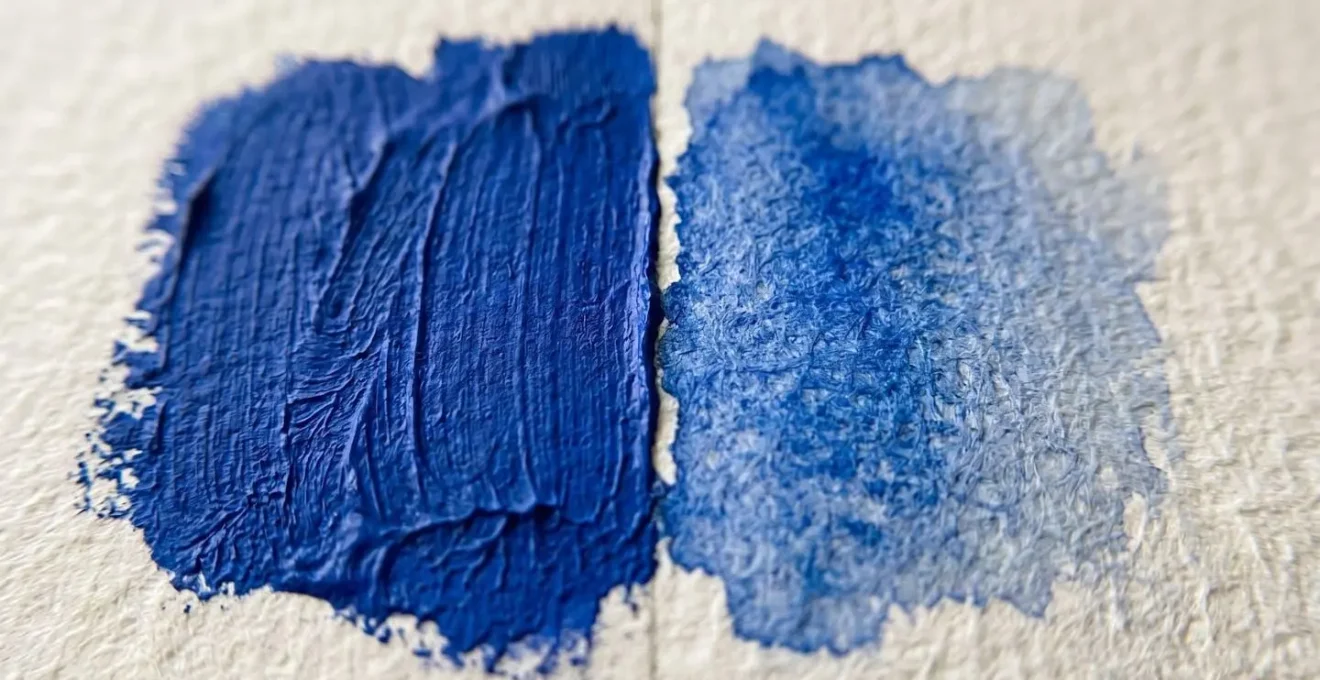
Ultimately, as the experts at the Acrylic Painting School note, « Acrylic paint is the best option for beginners: it is easier to master and more forgiving your mistakes while you’re learning. » Choosing a forgiving medium is a therapeutic act of kindness to your creative self.
Instagram vs Private Journal: Where Should You Keep Your Art?
In our hyper-connected world, the default impulse is often to share our creations on social media. But for an artist struggling with imposter syndrome, making your art public can feel like stepping onto a stage under a harsh spotlight. The pursuit of likes and validation can quickly transform a joyful act of self-expression into a stressful performance. The alternative, a private journal, offers a sanctuary—a lab notebook where process is the hero, not the polished result.
The primary function of a private journal is to decouple the act of creating from the anxiety of being judged. It becomes a space for « process artifacts »—the messy sketches, the failed attempts, the color swatches, the written notes. It’s a place to be bad, to experiment, to play without an audience. This builds a foundation of creative work and confidence that is internal, not dependent on external validation.
The 100-Day Private Archive Method
Artist Liz Steel implemented a personal strategy of maintaining a completely private sketchbook for 100 consecutive days before considering any public sharing. This approach decoupled the act of creating from the anxiety of external validation, allowing her to build a substantial body of work and develop genuine confidence in her process. The method transformed her journal from a performance space into a ‘lab notebook’ where process became the hero, not the polished result. By the end of the 100 days, she had cultivated a frictionless creative workflow and a private visual archive that documented authentic growth rather than curated highlights.
This doesn’t mean you must hide your work forever. The key is to find a « third place » for sharing that balances privacy with connection. This could be a private Instagram account for a few trusted friends, a small Discord channel with fellow beginners, or simply reframing your captions to invite conversation about the process rather than judgment on the outcome. For example, instead of « My new painting, what do you think? », try « Today I was trying to capture the feeling of a quiet morning. » This small shift invites empathy, not critique.
The Social Media Mistake That Kills Your Unique Artistic Voice
The most common advice given to artists with imposter syndrome is to « stop comparing yourself to others on social media. » While well-intentioned, this advice is incomplete. The real mistake is not the comparison itself, but the internalization of the illusion of effortless perfection. You are not just comparing art; you are comparing your messy, private, real-life beginning to someone else’s curated, edited, and polished final product.
Social media algorithms are designed to show you what is popular and polished, creating an echo chamber of trends and seemingly flawless execution. This can unconsciously pressure you into chasing a « style » that isn’t your own, simply because it gets likes. This pursuit kills your unique artistic voice before it even has a chance to develop. Your authentic voice emerges from your life experiences, your mistakes, your unique way of seeing the world—the very things that don’t fit into a tidy, trending aesthetic. As the Milan Art Institute aptly puts it, this comparison « is the core fuel for imposter syndrome. »
The solution is to consciously change how you consume, not just what you create. Use social media as a tool for discovery, not a mirror for self-worth. Follow artists whose *process* you admire, not just their final work. Look for the messy studio shots, the failed experiments, the story behind the art. Mute or unfollow accounts that consistently make you feel inadequate. Remember that what you see online is a highlight reel, not the full, unedited film of someone’s creative life.

Your goal is not to replicate a style you see online, but to document your own reality. The most « unique » art you can make is the art that is most honest to your own experience. Protect that honesty by curating your digital environment as carefully as you curate your physical one.
How to Set Up a Studio Corner in a Tiny Apartment?
The idea of a dedicated « studio » can feel intimidating and out of reach, especially if you live in a small space. This feeds into the imposter syndrome narrative that « real artists » have sprawling, light-filled lofts. But the goal is not to have a perfect studio; it’s to have a frictionless workflow. The best studio, no matter its size, is the one that minimizes the energy required to start creating.
A tiny corner of a kitchen table can become a powerful creative space if it’s set up with intention. The key is to create an « Art-in-a-Box »—a self-contained, portable kit with everything you need for one specific activity. Whether it’s a small watercolor tin, a few pencils, and a sketchbook, or an iPad and a charger, everything should be in one place. The goal is to be able to go from feeling the urge to create to making your first mark in under 60 seconds.
Transforming this corner into a « studio zone » is also a psychological act. Use sensory cues to signal to your brain that this is a sacred space for creativity. This could be a specific lamp you only turn on when you’re making art, a dedicated playlist, or the ritual of making a cup of tea. These small actions create a « Ritual of Assembly, » framing the act of setting up not as a chore, but as the official start of your creative time.
Artist Kateri Ewing famously maintained a daily practice for years from a corner of her kitchen table. Her setup was simple: a sketchbook, a few materials, and her morning coffee. By integrating art into an existing habit, she removed the friction and made creativity an effortless part of her day. This proves that the size of your space is far less important than the consistency of your ritual.
Your Action Plan: Auditing Your Space for Psychological Safety
- Points of Contact: List every physical and digital place you create or think about creating (e.g., your desk, the kitchen table, Instagram, your notes app).
- Friction Inventory: For each point, list the barriers. Are your supplies buried in a closet? Does your phone buzz with notifications? Be brutally honest about what stops you from starting.
- Safety Check: Confront each barrier with a question: « Does this make me feel safe to fail? » A blank, expensive canvas might feel unsafe. A public Instagram feed might feel unsafe.
- Emotional Scan: Identify which spaces feel like a « playground » (low-stakes, fun) versus a « stage » (high-stakes, performative). Your goal is to maximize playground time.
- Integration Plan: Create one « Art-in-a-Box » for your primary physical space. On your phone, create a folder of apps for inspiration and hide the social media apps that trigger comparison.
How to Enjoy Being Bad at Something New as an Adult?
As adults, we are conditioned to be competent. We are professionals, parents, experts in our fields. This makes the clumsy, awkward phase of learning a new skill—especially a creative one—feel deeply uncomfortable. The inner critic screams, « You should be better at this by now! » To enjoy being a beginner, you must consciously give yourself permission to be « bad » and fundamentally redefine what « success » means in your creative practice.
The most powerful tool for this is a psychological technique: the separation of identity from activity. As the Arts to Hearts Project explains, this is a crucial linguistic and mental shift.
Introduce the linguistic shift of separating ‘Identity’ from ‘Activity’. You are not a ‘bad artist’; you are a person learning how to draw. This simple change creates the emotional distance needed to enjoy the clumsy, awkward, and often hilarious process of being a beginner.
– Arts to Hearts Project, Getting Imposter Syndrome? Here’s How Artists Really Cope
Once you’ve created this emotional distance, you can replace traditional metrics of success (like « Is this drawing good? ») with new, playful ones. The goal is to measure process, not product. Think of them as « silly metrics » designed to reward curiosity and participation. For example, instead of judging the aesthetic quality of a sketch, you could ask:
- Did I learn one new thing today? (e.g., how a shadow falls on a cup)
- Did making this surprise me or make me laugh?
- How many different colors did I get to use?
- Did I show up and start? (The ultimate metric)
Another powerful strategy is the « Secret Subject » method. Choose one mundane, low-stakes object—your coffee mug, a particular shoe, a plant on your windowsill—and draw it repeatedly over weeks or months, in private. Watching your own tangible progress on a single, unimportant subject is a powerful, concrete antidote to the vague feeling that you’re not improving. It provides personal proof of your growth, which is far more convincing than any external compliment.
The Copyright Mistake That Could Get Your AI Art Sued
In the face of imposter syndrome, the allure of AI art generators can be strong. They promise instant, polished results, seemingly bypassing the difficult, messy work of learning to draw. However, leaning on AI as a crutch rather than a tool not only stunts your growth but also opens you up to significant ethical and legal risks, particularly around copyright.
The biggest mistake is using AI-generated images as your final artwork without significant transformation. Many AI models are trained on vast datasets of images scraped from the internet, which often include copyrighted work. If your AI-generated piece is « substantially similar » to an existing artist’s work, you could be liable for copyright infringement. The legal landscape is still evolving, but relying on AI for execution is a risky path.
A healthier, safer approach is to use AI for what it’s good at: idea generation and inspiration, not final execution. Use it as a brainstorming partner to break out of creative ruts. Feed it bizarre, non-human prompts to generate unexpected color palettes or compositions. But the final execution—the hand-drawn lines, the brushstrokes, the personal decisions—must be yours. This leverages AI’s strength while ensuring the final piece contains your « human fingerprint, » the one thing that gives it unique value and protects you legally.
Instead of fearing copyright law, see it as a source of freedom. The vast library of works in the Public Domain offers a legal and ethical sandbox. You are free to copy, study, and learn from the old masters without any risk. This builds real skill and understanding, which is a far more durable foundation for confidence than the instant gratification of AI.
Key Takeaways
- Build Psychological Safety: Your primary goal is to create an environment (physical and mental) where mistakes are not just tolerated, but welcomed as part of the process.
- Engineer a Frictionless Workflow: Make starting so easy it’s harder to avoid. A 10-minute habit with an « Art-in-a-Box » kit is more powerful than waiting for a 4-hour slot of inspiration.
- Separate Identity from Activity: You are not a « bad artist. » You are a person learning a new skill. This distinction gives you the emotional space to enjoy being a beginner.
Why Reading Fiction Improves Your Ability to Read People in Real Life?
It may seem unrelated, but one of the most powerful tools for overcoming artistic imposter syndrome can be found on your bookshelf: reading fiction. The title of this section asks about reading other people, but its true power lies in how it teaches you to read—and be compassionate toward—yourself. Fiction is a training ground for the « empathy muscle » that directly weakens the inner critic.
When you read a novel, you are invited into the inner world of a character. You witness their journey in its entirety: their flaws, their struggles, their small victories, and their non-linear path to growth. You learn to root for them despite their mistakes. This process trains your brain to hold space for imperfection and to see failure not as an endpoint, but as a crucial chapter in a larger story. As Art Prof highlights in their analysis, by understanding a flawed character’s journey, you learn to apply that same compassionate lens to your own flawed, non-linear creative journey.
This narrative understanding helps you reframe your own « bad » art. A clumsy sketch is no longer evidence of your failure as an artist; it is simply page 37 in the epic novel of your creative development. Without this chapter, you can’t get to the satisfying conclusion on page 300. Reading fiction provides a model for this compassionate, long-term perspective.
Furthermore, fiction can provide a direct solution to the paralyzing question of « what to draw? » A detailed description of a room in a novel, a character’s face, or a landscape can serve as a ready-made « observational prompt. » Trying to sketch the scene from a chapter removes the pressure of invention and transforms the activity into a simple exercise in observation and interpretation. It builds your technical skills while reinforcing the narrative-thinking that fosters self-compassion.
Your next step isn’t to create a masterpiece, but to take one small, safe action. Choose one tip from this guide—whether it’s setting a 10-minute timer, buying a cheap sketchbook, or reading a chapter of a novel with an artist’s eye—and dedicate a small moment to it today. That is the real work of an artist.