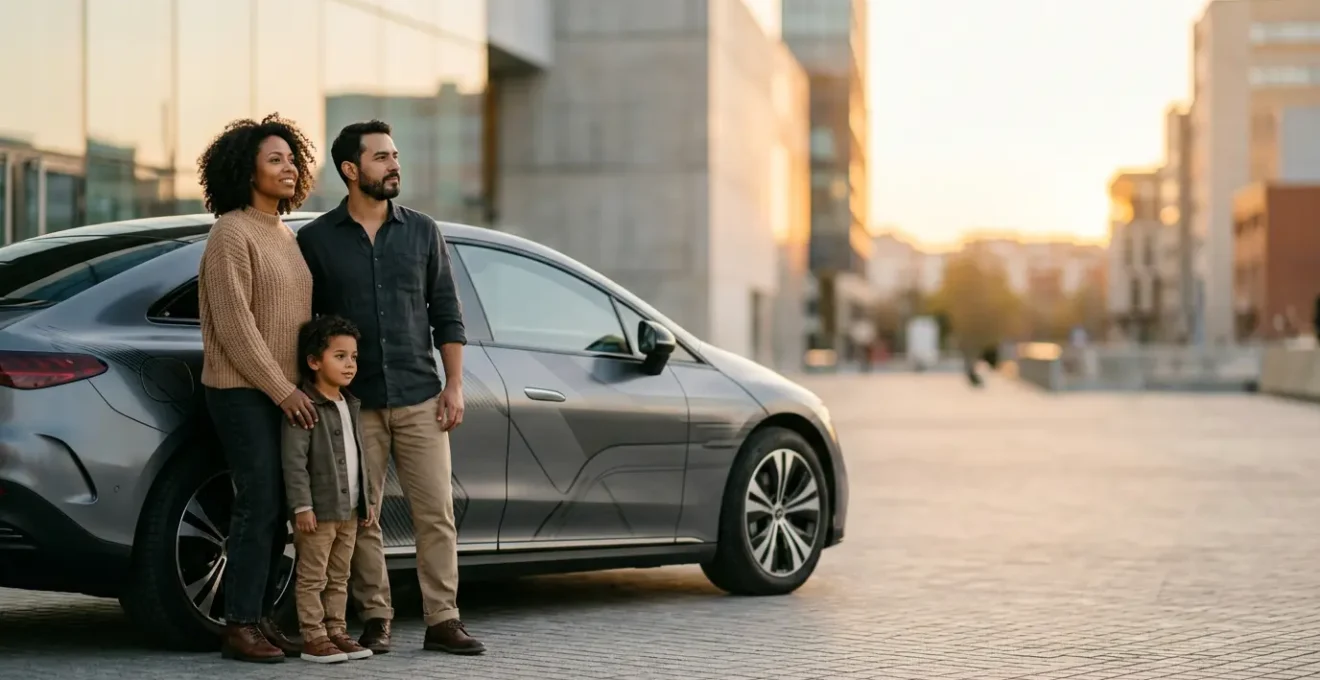
Contrary to the hype, the path to trusting self-driving cars isn’t about waiting for perfect AI. As an engineer in this field, I can tell you the real challenge is closing the dangerous gap between marketing promises, current engineering reality, and a driver’s understanding. This article unpacks the critical safety, legal, and ethical questions you must consider before putting your family in the hands of an algorithm.
The promise is captivating: a future where your car navigates traffic, avoids hazards, and delivers your family safely to their destination while you relax. For any parent, the idea of eliminating the risk of human error from the driving equation is a powerful one. Automakers are racing towards this vision, with marketing campaigns that often suggest a fully autonomous future is just around the corner. We see commercials of drivers with their hands off the wheel, seemingly entrusting their entire journey to the vehicle.
Yet, for safety-conscious drivers, this vision is met with healthy skepticism. If the car makes a mistake, who is responsible? How does it make life-or-death decisions in a split second? The common discussion often gets stuck on the « levels » of autonomy, a technical framework that fails to capture the real-world complexities. The truth is, the most significant risks today don’t come from malicious AI, but from the misunderstanding of what current systems can and cannot do.
This article moves beyond the marketing and dives into the engineering reality. Guided by a balanced, forward-looking perspective, we will not simply ask *if* the technology will be ready, but explore what it takes to build genuine, justified trust. Our focus will be on the critical gaps—in technology, law, and human-computer interaction—that must be closed before any of us can confidently answer « yes » to the question of our family’s safety. We’ll examine the disconnect between perception and reality, the ethical dilemmas engineers are grappling with, and the evolving legal landscape that could directly impact you.
To navigate these complex topics, this guide is structured to address the most pressing concerns for any skeptical driver. We will break down the crucial issues one by one, providing clarity on what the technology truly means for your safety today and in the near future.
Summary: Navigating the Road to Autonomous Trust
- Why Level 2 Autonomy Is Not « Self-Driving » Despite Marketing Claims?
- How to Drive Safely Around Testing Autonomous Vehicles in Your City?
- The Trolley Problem 2.0: Who Does the Car Protect in an Unavoidable Crash?
- The Legal Gap That Could Leave You Liable Even If the Car Was Driving
- How Human-Machine Interfaces Are Evolving to Reduce Driver Anxiety?
- Why AI Hallucinations Make Chatbots Unreliable for Factual Research?
- Why Free Transit Apps Are Hungry for Your Your Real-Time Location Data?
- How to Save 20 Minutes on Your Daily Commute Using MaaS Aggregators?
Why Level 2 Autonomy Is Not « Self-Driving » Despite Marketing Claims?
The single most dangerous misunderstanding in automotive technology today is the belief that Level 2 driver-assistance systems are « self-driving. » They are not. A Level 2 system, like Tesla’s Autopilot or GM’s Super Cruise, can manage steering and speed under specific conditions, but it requires the driver to remain fully attentive and ready to take control at any moment. The « autonomy » is merely supportive. This disconnect between marketing monikers and engineering reality has tangible consequences; consumer confidence dropped to a score of just 37 out of 100 in the United States, largely due to this confusion.
Industry analysis highlights the problem, noting that « many people don’t like how Tesla is potentially misleading consumers with Autopilot, a moniker that indicates a lot more than Level 2 automation. » From a safety engineering perspective, the primary danger is cognitive disengagement. When a system performs well 99% of the time, it’s human nature to start trusting it implicitly, checking emails, or looking away. But it is in that 1% of edge cases—an unusual road obstacle, a sudden change in weather, or a faded lane marking—that the system may fail without warning, and a disengaged driver is unprepared to react in time.
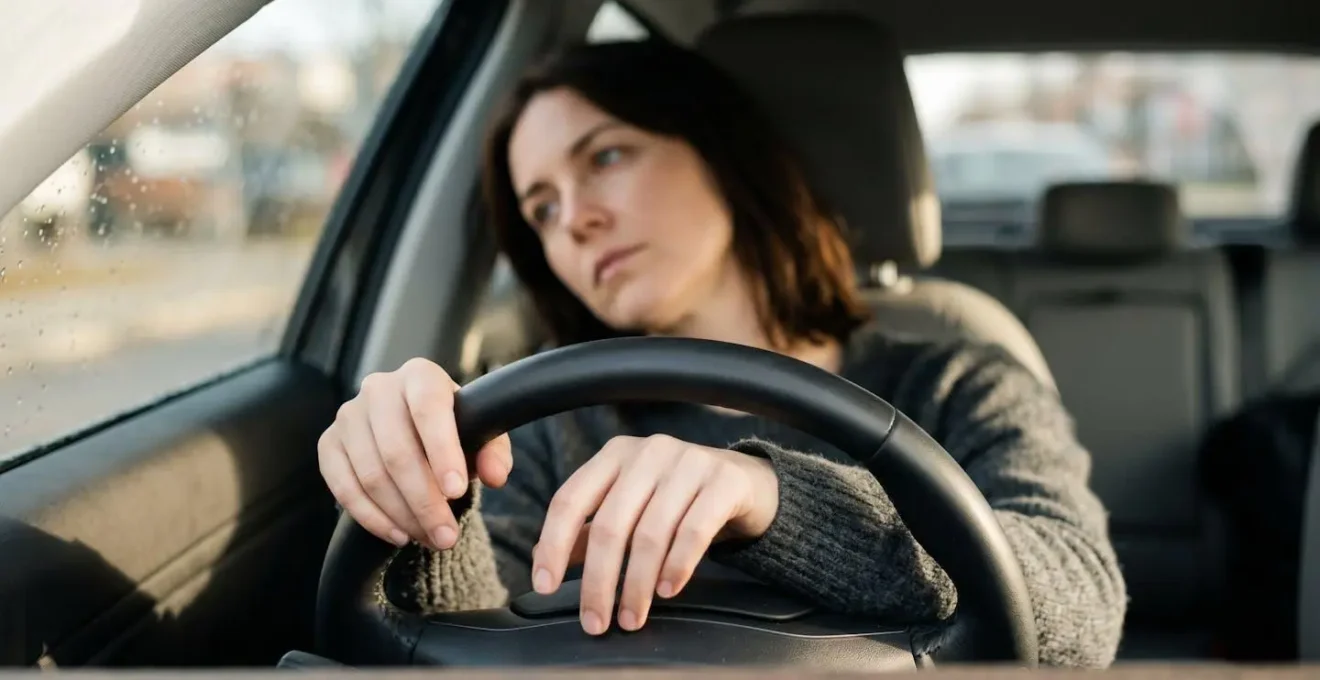
As the image above illustrates, the relaxed posture can be deceiving. True safety with Level 2 systems relies on the driver’s brain, not just their hands on the wheel. Automakers are implementing robust Driver Monitoring Systems (DMS) that use cameras to track eye movement and head position to combat this. If the system detects inattention, it will issue alerts and may even disengage. Until a vehicle is officially rated at Level 4 or 5, where the car is responsible for the entire journey in specified (L4) or all (L5) conditions, the driver is—and always will be—the ultimate safety system.
How to Drive Safely Around Testing Autonomous Vehicles in Your City?
With industry reports showing more than 2,000 robotaxis already operating on public roads for testing and commercial services, encountering an autonomous vehicle (AV) is becoming increasingly common. These vehicles, covered in sensors and often branded with company logos like Waymo or Cruise, can behave differently from human drivers. They are programmed for maximum safety and adherence to traffic laws, which can sometimes translate into behaviors that feel unnatural to us. They may brake more abruptly if a pedestrian is near a crosswalk, maintain a larger following distance, or hesitate at complex intersections.
The key to driving safely around them is predictability. Avoid sudden lane changes or aggressive maneuvers near an AV. Use your turn signals well in advance and maintain a consistent speed. Because they are programmed to follow rules to the letter, they expect other drivers to do the same. Treating them like a very cautious student driver is a good mental model. Remember that even in test vehicles, a human safety operator is typically present and ready to intervene, but giving the system space to operate as designed is the safest approach for everyone.
While these vehicles undergo millions of miles of testing, glitches can occur. If you witness an AV behaving erratically or dangerously, you have a role to play in improving the technology. Reporting these incidents provides crucial data for regulators and developers. Knowing what information to capture at the moment is vital for a useful report.
Your Action Plan: Reporting Erratic Autonomous Vehicle Behavior
- Document Location & Time: Record the exact time and location of the incident. Use GPS coordinates from your phone or note the nearest street address and cross-street.
- Identify the Vehicle: Note the vehicle’s license plate number and any visible branding (e.g., Waymo, Cruise) or identification numbers on the car’s body.
- Capture Evidence: If it’s safe to do so, have a passenger capture video or photos of the vehicle’s behavior. Focus on showing the erratic movements in the context of the surrounding traffic.
- Note the Conditions: Document the environmental conditions. Was it raining? Sunny with harsh glare? Was the traffic heavy or light? These details are critical for engineers to diagnose the issue.
- File a Report: Submit your documented incident to the appropriate authorities. In the U.S., this can be done through the NHTSA’s AV TEST Initiative tracking tool and your state’s Department of Motor Vehicles (DMV).
The Trolley Problem 2.0: Who Does the Car Protect in an Unavoidable Crash?
The « trolley problem » is a classic ethical thought experiment, and for autonomous vehicles, it’s no longer theoretical. In a no-win crash scenario, should the car be programmed to swerve and hit a single pedestrian to save a family of five on the other side of the road? Or should it prioritize the safety of its own occupants above all else? As a research study from Frontiers in Robotics and AI notes, « AVs are among the first autonomous agents that make decisions with potential life-and-death consequences. » This question places an immense ethical burden on automotive engineers and programmers.
However, the public debate often misunderstands how manufacturers are approaching this. The reality is less about programming explicit ethical hierarchies and more about focusing relentlessly on collision avoidance. The goal is to make the car so good at perceiving and predicting hazards that the « trolley problem » scenario never arises. But what if it does? Analysis of manufacturer safety documentation, such as that of Mercedes-Benz, reveals a nuanced strategy. Instead of publicly declaring « we will sacrifice X to save Y, » companies are engaging in what can be called ethical deferral. They are designing systems to comply strictly with existing traffic laws and regulations, effectively pushing the moral decision-making onto the legal framework society has already built.
In practice, this means the car’s primary directive is to mitigate the severity of any impact by braking and maneuvering within the bounds of the law. The system isn’t choosing *who* to hit; it’s desperately trying to hit *nothing* or, failing that, to reduce speed and impact force as much as possible. This approach avoids programming controversial value judgments, but it leaves the ultimate ethical question unanswered, deferring it to post-crash legal and insurance investigations. For a parent, this means there is currently no car you can buy that is explicitly programmed to prioritize its occupants at the expense of others in all situations.
The Legal Gap That Could Leave You Liable Even If the Car Was Driving
When an autonomous-capable vehicle is involved in an accident, the first question is always: who is at fault? The driver, the automaker, or the software developer? This question exposes a massive legal gray area, which we in the industry refer to as the « liability gap. » With current Level 2 systems, the answer is clear: the driver is always responsible. But as we move toward higher levels of automation, the lines blur. This is not a distant problem; in scenarios where NHTSA data shows 1,450 self-driving car accidents in 2022, determining liability has already become a complex legal challenge.
The core of the issue is that our laws were written for human drivers. Proving whether an accident was caused by a system failure, a sensor limitation, or a driver’s failure to supervise properly is incredibly difficult. The primary piece of evidence in these cases is the vehicle’s Event Data Recorder (EDR), or « black box, » which logs data about the car’s speed, braking, steering inputs, and the status of its automated systems in the moments before a crash. This data becomes the focal point of any investigation, but access to it and its interpretation are highly contentious.
Furthermore, liability laws are not uniform. They are a patchwork of state-level regulations that are evolving in real-time. A framework that applies in California may be completely different from one in Texas or Tennessee, creating confusion for consumers and insurers alike.
| State | Liability Framework | Insurance Requirements |
|---|---|---|
| California | Hybrid personal/product liability | $5 million minimum for testing fleets |
| Arizona | Commercial fleet focused | Higher coverage limits for commercial AVs |
| Texas | Freight and logistics emphasis | Commercial fleet coverage with telematics |
| Tennessee | Registration-based certification | Standard auto insurance with AV endorsement |
| Arkansas | Modified comparative negligence | Appropriate insurance (not specified) |
How Human-Machine Interfaces Are Evolving to Reduce Driver Anxiety?
There’s a fascinating paradox in public perception of autonomous vehicles. On one hand, a survey found that while nearly 54% of global respondents believe automated cars would drive more efficiently and 47% believe they would be safer, many drivers still feel a deep sense of anxiety when relinquishing control. This fear of the unknown is a major barrier to adoption. As engineers, we recognize that building a technically perfect system isn’t enough; we must also build a system that users can understand and trust.
This is the domain of the Human-Machine Interface (HMI)—the collection of screens, sounds, and signals through which the car communicates with the driver. Early HMIs were often confusing, leaving the driver guessing what the car was seeing or planning to do next. This uncertainty is a direct cause of anxiety. The solution lies in a principle we call trust calibration: designing the interface to give the driver a clear, accurate mental model of the system’s capabilities and limitations. It’s not about blind trust, but appropriate trust.
Modern HMIs are evolving to achieve this through radical transparency. For example, the central display might show a real-time, simplified visualization of what the car’s sensors « see »—other cars, pedestrians, lane lines, and traffic signs. When the car plans to change lanes, it might highlight the intended path on the screen seconds before the maneuver begins. This « show, don’t just tell » approach gives the driver confidence that the system is aware of its surroundings and has a clear plan. As one Washington State University study aptly concluded, building this confidence is paramount:
Trust in the autonomous vehicles’ reliability and performance played the strongest role in improving perceptions of the technology’s risk.
– Kathryn Robinson-Tay, Washington State University Journal of Risk Research Study 2024
Why AI Hallucinations Make Chatbots Unreliable for Factual Research?
The term « AI hallucination » has become widely known in the context of chatbots like ChatGPT, where the model confidently invents facts, sources, or events. While this can be a frustrating or amusing quirk in a research tool, the same underlying principle represents a life-or-death risk in an autonomous vehicle. When an AV’s perception system « hallucinates, » it might misinterpret a shadow on the road as a physical obstacle and brake dangerously, or worse, fail to identify a real hazard right in front of it.
As a safety engineer, I can assure you that preventing these perception errors is one of the highest priorities in AV development. Unlike a chatbot that relies on a single large language model, an autonomous vehicle’s « brain » never trusts a single source of information. It operates on a principle of sensor fusion, creating what we call a « consensus reality » by cross-referencing data from multiple, diverse sensor types. The system combines inputs from cameras (which see color and texture), LiDAR (which measures distance with extreme precision using lasers), and radar (which works well in bad weather and measures object velocity).
This redundant, multi-layered approach acts as a built-in fact-checker against hallucinations. If one sensor makes a mistake, the others are there to correct it.
Case Study: Sensor Fusion Safeguards
In rigorous testing environments, AVs are subjected to scenarios designed to trick their sensors. For example, a test might involve a large plastic bag flapping in the wind at the edge of the road. A camera-only system might momentarily misclassify this as a pedestrian and trigger an unnecessary emergency brake. However, in a system with sensor fusion, the LiDAR data would report no solid object of that shape, and the radar would show its movement is not consistent with a person. The conflicting data allows the system to correctly dismiss the camera’s initial error, preventing a dangerous and incorrect maneuver. This process of creating a « consensus reality » is fundamental to building a reliable perception system.
Why Free Transit Apps Are Hungry for Your Your Real-Time Location Data?
Many of us use free transit or navigation apps without a second thought, understanding that the price we pay is our real-time location data. This data is valuable for advertisers and city planners. As we look toward a future of autonomous vehicles, it’s crucial to recognize that cars are becoming the most powerful mobile data collection platforms ever created. Just like a smartphone, a connected car knows where you are, where you’ve been, how fast you drive, and even where you shop. And the scale of this data collection is set to explode.
The autonomous vehicle sensor market, which includes the cameras, LiDAR, and radar that « see » the world, is predicted by Roots Analysis to expand from nearly $6 billion in 2025 to over $108 billion by 2035. Each of these sensors generates a torrent of information, not just about road conditions, but potentially about the environment around your home, your children’s school, or your workplace. This data is essential for the car’s operation, but it also creates an unprecedented trove of personal information.
Privacy advocates are already raising alarms. A 2026 legal analysis from Retcho Agency went so far as to suggest « looking for model years prior to 2024 if you want to avoid ‘always-connected’ monitoring. » While this may be an extreme view, it highlights a valid concern for families. Who owns the data your car collects? How is it being used, and with whom is it being shared? Will your driving habits affect your insurance premiums in real-time? These are unresolved questions. As with social media and smartphones, the convenience of connected services will come with a significant privacy trade-off, one that every family will need to evaluate carefully.
Key Takeaways
- Level 2 Is Not Self-Driving: The biggest risk today is over-trusting driver-assist systems. The driver must always be in command.
- Liability is Unresolved: In the event of a crash with a highly automated system, the legal gray area between driver and manufacturer fault is significant and varies by state.
- Trust Requires Transparency: Confidence in AVs will be built through transparent interfaces (HMIs) that show what the car sees, not through marketing hype.
How to Save 20 Minutes on Your Daily Commute Using MaaS Aggregators?
The concept of Mobility-as-a-Service (MaaS) is already changing how we think about commuting, using apps to aggregate options like ride-sharing, public transit, and e-scooters. However, the true game-changer for MaaS will be the integration of fully autonomous vehicles. Imagine a future where, instead of owning a car that sits idle 95% of the time, you summon an autonomous pod that takes you to work via the most efficient route, all for a low subscription fee. This isn’t science fiction; it’s the end-game that companies like Waymo, Cruise, and Baidu are actively building.
While the vision is compelling, the timeline must be realistic. Projections from McKinsey estimate that 12% of new passenger cars by 2030 may include Level 3+ autonomous technologies, rising to 37% by 2035. The rollout will be gradual and likely concentrated in dense urban areas first, where robotaxi services can operate most efficiently. A case study of the current market shows this is already underway: key players have accumulated tens of millions of miles and are operating commercial driverless services in cities across the US and China. Baidu, for example, aims to have 1,000 robotaxis operating in Wuhan alone by the end of 2024.
This shift from personal car ownership to on-demand autonomous mobility represents a fundamental transformation in our relationship with transportation. For families, this could mean reduced costs, less time wasted in traffic, and increased accessibility. But it also means ceding control and placing trust in a fleet operator’s technology and safety protocols. The journey to saving 20 minutes on your daily commute will be intertwined with all the safety, legal, and ethical questions we’ve discussed.
The road to 2030 is not about a sudden leap to full autonomy, but a gradual process of building technology and, more importantly, building justified trust. To make an informed decision for your family, stay critical, ask hard questions, and demand transparency beyond the marketing slogans.