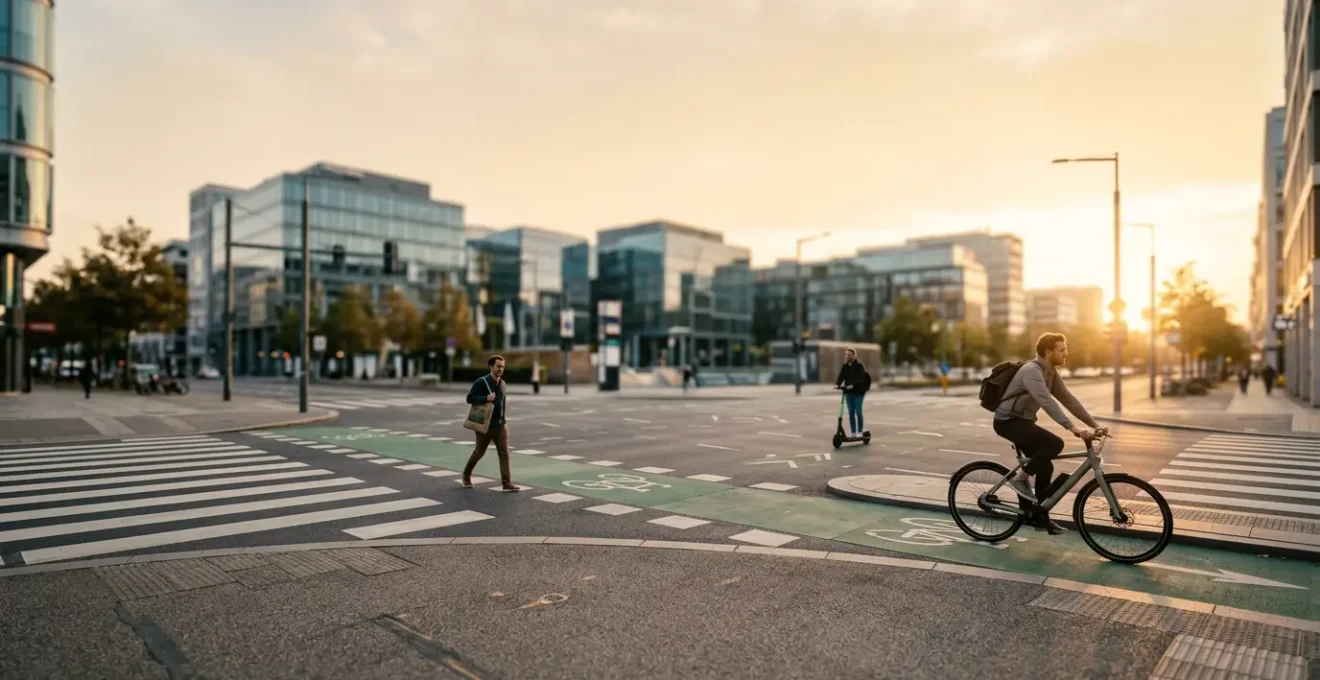
The common belief that ditching your car means sacrificing time and convenience is fundamentally wrong; it’s a failure of strategy, not concept.
- Your car is likely costing you over $1,000 a month in total ownership costs, far beyond just gas and insurance.
- Combining public transit with « last-mile » solutions like a foldable bike or an e-scooter often beats car commute times in congested urban areas.
Recommendation: Stop thinking in terms of a single car replacement and start building a flexible, multi-modal commute system. The goal isn’t sacrifice; it’s strategic arbitrage of your time and money.
Let’s be direct. The idea of giving up your car, even for a month, probably fills you with dread. You picture longer, more complicated journeys, being at the mercy of delayed trains, or arriving at work drenched in rain. The conventional wisdom is that a car equals freedom and efficiency, and any alternative is a noble sacrifice for the planet that costs you your most valuable asset: time. This is the central myth that keeps you stuck in traffic, burning money every minute you sit idle.
The typical advice you’ve heard— »just take the bus » or « buy a bike »—is lazy and incomplete. It ignores the reality of urban life: the « last mile » from the station to your office, the need to carry a laptop, and the simple fact that public transit routes don’t always align with your life. These partial solutions are why attempts to go car-free often fail, reinforcing the idea that it’s an impossible trade-off. But what if the trade-off itself is a fiction? What if the true key isn’t replacing your car with one thing, but with a smarter system?
As an urban mobility planner, I see this problem not as an environmental challenge, but as a systems engineering one. Your commute isn’t a single line from A to B; it’s a network of possibilities. The strategy is to exploit the inefficiencies of car travel (traffic, parking, hidden costs) and perform a « commute arbitrage » by combining the strengths of different modes. This guide will provide a practical framework to do just that, moving from a rigid, expensive dependency on one vehicle to a flexible, cost-effective, and surprisingly efficient multi-modal system. We will deconstruct the true cost of your car, design an integrated commute, navigate the critical safety issues, and quantify the real-world health benefits that can replace your gym membership.
This article provides a complete roadmap for shifting your perspective and your daily travel. By following this strategic plan, you will discover how to build a commute that works for you, not the other way around.
Summary: A Strategic Plan for a Faster, Cheaper, Car-Free Commute
- Why Your Car Actually Costs You $500 More Per Month Than You Think?
- How to Combine Train and Foldable Bike for the Ultimate Commute?
- Purchase vs Rental: Which E-Scooter Strategy Saves Money After 6 Months?
- The « Door Zone » Mistake That Injures Urban Cyclists Every Day
- How to Map a Cycle Route That Avoids 40% of City Pollution?
- Straws vs Votes: Which Action Actually Moves the Needle on Carbon?
- Why E-Biking Still Burns 300 Calories an Hour Despite the Motor?
- How to Replace Your Gym Cardio with a Shared E-Bike Commute?
Why Your Car Actually Costs You $500 More Per Month Than You Think?
The first step in any strategic shift is to understand the true cost of the status quo. Most drivers calculate their car expenses based on the two most visible costs: fuel and insurance. This is a dangerous oversimplification. The real financial drain of car ownership is hidden in factors that you don’t pay for on a daily basis but that accumulate into a staggering sum. The biggest culprit is depreciation: the silent loss of value your vehicle experiences every single day, whether you drive it or not.
When you factor in maintenance, repairs, taxes, fees, and the silent killer of depreciation, the numbers paint a starkly different picture. Industry analysis provides a sobering baseline. For instance, according to AAA’s 2024 Your Driving Costs study, the average annual cost to own and operate a new vehicle has climbed to $12,297, or $1,024.71 per month. This figure isn’t an outlier; it’s the norm for a new car driven 15,000 miles a year.
Even if you drive less, the hidden costs remain substantial. Separate data from AAA shows that depreciation alone can cost an average of $4,334 annually. That’s over $360 per month your car loses in value before you’ve even paid for a gallon of gas. This doesn’t even touch on the « shadow work » of car ownership: the time spent searching for parking, sitting in traffic, or dealing with unexpected breakdowns. Your car isn’t just a tool; it’s a part-time job you pay for. Understanding this true, all-in cost is the motivation to build a better system.
How to Combine Train and Foldable Bike for the Ultimate Commute?
The most effective way to beat urban traffic is not to find a faster car, but to bypass the roads where cars are trapped. This is the core of multi-modal commuting: using mass transit for the long haul and a personal mobility device for the « first and last mile. » The combination of a train and a high-quality folding bike represents the pinnacle of this strategy, offering unparalleled speed, flexibility, and efficiency.
A folding bike isn’t just a smaller bicycle; it’s a key that unlocks the full potential of the public transit network. It transforms a 15-minute walk from the station into a 3-minute ride, effectively eliminating the single biggest time-sink of a non-car commute. The key is seamless integration. A good folding bike should be light enough to carry up stairs and fold quickly enough that you’re not fumbling on a crowded platform. This synergy allows you to leapfrog traffic jams on the train and then zip past gridlocked cars on your way to the office.
This photograph highlights the sophisticated engineering of a modern folding bike. The focus on the hinge mechanism isn’t just aesthetic; it’s the very technology that enables this powerful form of commute arbitrage.
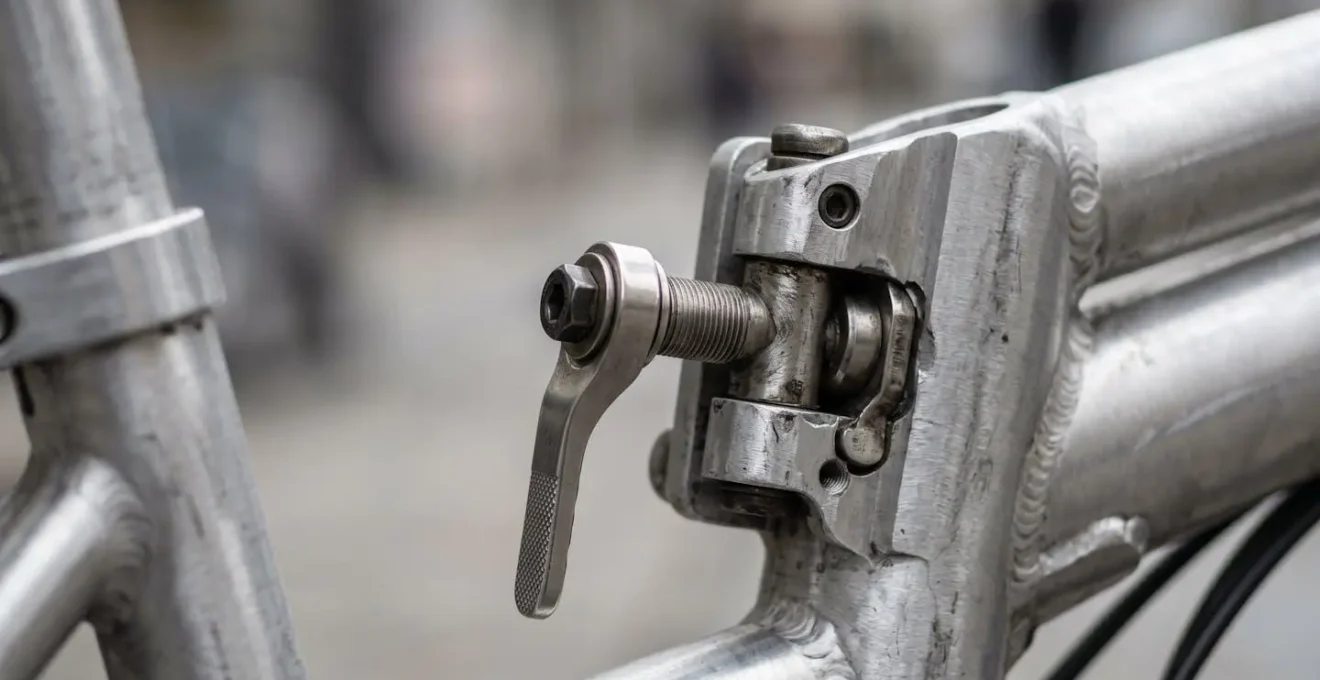
Mastering this system requires a few key techniques to make the transitions smooth and stress-free. It’s about thinking like a logistics expert, minimizing friction at every step. Here are the essential steps for a seamless train-bike commute:
- Choose a folding bike under 30 lbs, with an ideal weight of 20-25 lbs, that folds in under 20 seconds for rapid transitions.
- Don’t fold your bike until you are about to board; instead, push it through wide station gates and use elevators to reach platforms with minimal effort.
- Position yourself to fold the bike near the train door’s stopping point to minimize the distance you have to carry it.
- When possible, stow your folded bike on the floor of luggage racks, as it is heavier and more stable than most passenger bags on overhead racks.
- Always sit as close as possible to your stowed bike and keep an eye on it at each station to prevent theft.
Purchase vs Rental: Which E-Scooter Strategy Saves Money After 6 Months?
The electric scooter has emerged as a primary tool for solving the last-mile problem. But the choice between using a shared rental service (like Lime or Bird) and purchasing your own is a critical financial decision. For the casual user, renting is a low-commitment option. For the daily commuter, however, the math changes dramatically. The per-minute fees of rental scooters accumulate quickly, turning a convenient ride into a significant monthly expense.
The economics of ownership become compelling surprisingly fast. An analysis shows that with a median e-scooter purchase price of $450, the break-even point for a daily commuter can be reached in less than 2 months of daily use. After that point, every ride on an owned scooter is essentially free, aside from the negligible cost of electricity. Rental services, with their unlock fees and per-minute charges, are optimized for tourists and infrequent riders, not for the backbone of your daily commute.
The following table, based on typical usage for a daily 5-mile commute, breaks down the costs over a six-month period. It clearly illustrates the point at which ownership transitions from an upfront cost to a massive saving.
| Cost Factor | Rental (Lime/Bird) | Purchase (Average) |
|---|---|---|
| Initial Cost | $0 | $300 (e-scooter) |
| Per-Ride Cost (5 miles) | ~$6 ($1 unlock + $5 per-minute) | $0 (after purchase) |
| Monthly Cost (daily commute) | ~$240 (40 rides) | $0 operational |
| 6-Month Total | ~$1,440 | $300 + minimal charging (~$10) |
| Break-Even Point | – | 1.25 months for daily users |
The data is unequivocal. For anyone planning to replace their car commute, purchasing an e-scooter is not an expense; it’s an investment with a rapid and high return. The rental model offers flexibility, but the ownership model offers freedom from recurring costs—a core principle of effective commute arbitrage.
The « Door Zone » Mistake That Injures Urban Cyclists Every Day
Transitioning to cycling in an urban environment requires more than just a bike; it requires a new set of defensive skills. The single most dangerous and commonly underestimated threat to an urban cyclist is the « door zone »—the space adjacent to parked cars where a suddenly opened door can cause a catastrophic collision. This is not a freak accident; it’s a predictable and preventable event that constitutes a huge portion of urban cycling injuries.
Many cyclists, especially those new to city riding, instinctively hug the line of parked cars to stay as far away from moving traffic as possible. This feels safer, but it is the single greatest mistake you can make. You are riding directly in the line of fire. Data confirms the severity of this issue. For example, according to city data from Boston, dooring incidents accounted for 22% of all bicycle injuries over three years. This is not a minor risk. Broader studies across major cities show that dooring accounts for between 15-27% of urban bicycle collisions.
The only effective countermeasure is to « take the lane. » This means positioning yourself in the center of the traffic lane, far enough away from parked cars that a fully opened door cannot reach you. A good rule of thumb is to ride at least four to five feet away from the side of parked vehicles. This may feel intimidating at first, as cars will be behind you rather than beside you. However, you become far more visible to drivers, and you completely eliminate the risk of a dooring incident. It is a conscious, strategic decision to trade a perceived sense of security for a real, measurable increase in safety.
How to Map a Cycle Route That Avoids 40% of City Pollution?
A key benefit of ditching the car is improving your health, but riding through plumes of exhaust can feel counterproductive. The air quality on a busy arterial road can be drastically worse than on a parallel side street just a block or two away. Strategic route mapping isn’t just about finding the shortest path; it’s about designing a journey that minimizes your exposure to harmful pollutants like particulate matter (PM2.5) and nitrogen dioxide (NO2).
The principle is simple: avoid « street canyons. » These are roads lined with tall buildings that trap vehicle emissions, creating concentrated pockets of polluted air. Your goal is to find routes that are more open, have less traffic, and ideally incorporate green spaces like parks or riverside paths. Modern mapping apps are beginning to integrate this data. Tools like Google Maps now offer air quality layers, and specialized cycling apps like Komoot or Citymapper can help you prioritize « quiet » or « green » routes over the fastest, most traffic-heavy options.
However, technology is only a tool. The real skill is in the manual audit of your potential routes. Look for alternatives to major thoroughfares, even if it adds a minute or two to your journey. A road with a dedicated, separated bike lane is often a good indicator of a route designed with non-motorized traffic in mind. The cumulative effect of breathing cleaner air on your daily commute is a significant, long-term health investment. You can effectively create a « clean air corridor » for your daily travel with just a few small adjustments to your path.
Action Plan: Auditing Your Low-Pollution Commute Route
- Points of Contact: List all streets, bike paths, and parks on your proposed route from door to door.
- Collecte: Inventory existing elements. Note sections with heavy traffic, street canyons (tall buildings on both sides), and green spaces. Use an app’s air quality layer to get baseline data.
- Cohérence: Confront the route with your values. Does the fastest route align with your goal of a healthier commute? Identify the top 3 pollution hotspots.
- Mémorabilité/Émotion: Compare the experience. Is a ride through a park more valuable than saving 90 seconds on a congested avenue? Score each segment on a 1-5 scale for « pleasantness. »
- Plan d’intégration: Prioritize changes. Find parallel side-street alternatives for the identified pollution hotspots and test them one by one.
Straws vs Votes: Which Action Actually Moves the Needle on Carbon?
In the conversation around environmental impact, it’s easy to get lost in small, symbolic actions. We debate plastic straws while ignoring the systemic drivers of carbon emissions. Shifting your commute is a powerful move because it falls into the latter category. It’s not a symbolic gesture; it’s a significant, structural change to your personal carbon footprint. The transportation sector is one of the largest sources of greenhouse gas emissions, and your daily drive is a direct part of that.
Choosing to ditch your car is an action with leverage. Unlike refusing a plastic straw, which has a negligible individual impact, changing a daily, fossil-fuel-dependent habit creates a measurable reduction in CO2. A typical passenger vehicle emits about 4.6 metric tons of carbon dioxide per year. By eliminating that, you are making a personal contribution on a scale that few other individual actions can match. This is the difference between a vote and an opinion, between action and intention.
This visual represents the core of that choice: the tangible, natural world versus the abstract systems we build. Your commute is where these two things collide, and where you have the agency to choose a path with a lighter footprint.

Furthermore, this choice has a ripple effect. When more people choose active transport, it creates a mandate for better infrastructure—more bike lanes, safer pedestrian crossings, and more reliable public transit. Your individual action contributes to a collective demand for systemic change. It signals to policymakers and planners that the infrastructure of the future should not be built solely around the automobile. In this sense, your commute becomes a daily vote for the kind of city you want to live in. It’s one of the few areas where personal choice and systemic impact are directly and powerfully linked.
Why E-Biking Still Burns 300 Calories an Hour Despite the Motor?
A common misconception about electric bikes is that they are « cheating »—that the motor does all the work, turning a potential workout into a passive ride. This is fundamentally incorrect. An e-bike is not a scooter; it’s a « pedal-assist » system. The motor only engages when you are actively pedaling, amplifying your effort rather than replacing it. The result is a powerful form of exercise that is often more effective than traditional cycling for many people.
The reason e-biking is such effective exercise lies in a concept called sustained aerobic effort. On a conventional bike, a steep hill or strong headwind might force you to slow to a crawl or even stop, causing your heart rate to drop and breaking the aerobic zone. With an e-bike, the motor’s assistance allows you to power through these obstacles while maintaining a consistent level of exertion. You can keep your heart rate elevated in the optimal fat-burning and cardiovascular-conditioning zone for the entire duration of your ride.
Think of it this way: the e-bike motor lets you choose your effort level. You can set the assistance low and get a workout comparable to a regular bike, or set it higher to conquer a hill without exhausting yourself. This control allows you to ride for longer and more consistently than you might otherwise. Studies have shown that e-bike riders often get more total exercise per week than conventional cyclists because they ride more often and for longer distances. Burning 300-400 calories per hour is a realistic expectation for an average person on an e-bike, as you are still performing the physical work of pedaling; the motor just makes that work feel less strenuous.
Key Takeaways
- The true cost of car ownership often exceeds $1,000/month when including depreciation, far more than just fuel and insurance.
- A multi-modal commute (e.g., train + foldable bike) is a strategic system that often beats car travel time in congested urban areas.
- For daily use, purchasing an e-scooter or e-bike is a high-return investment, breaking even against rental costs in as little as 1-2 months.
How to Replace Your Gym Cardio with a Shared E-Bike Commute?
Now that we’ve established that e-biking is genuine exercise, the next logical step is to integrate it into your life as a replacement for dedicated gym time. This is the ultimate form of commute arbitrage: transforming dead travel time into a productive, health-boosting activity. Instead of paying for a gym membership you struggle to use, you can achieve your cardio goals as a built-in part of your daily routine.
To do this effectively, you need a simple framework. The goal is to match or exceed the cardiovascular effort of your typical gym session. A standard 30-minute cardio session on a stationary bike or elliptical might burn 250-350 calories. As we’ve seen, a 30-minute e-bike commute can easily achieve the same result. The key is to manage your effort and track your progress. Using a simple heart rate monitor (available on most smartwatches) is the best way to quantify your workout.
Aim to keep your heart rate in « Zone 2 » (typically 60-70% of your maximum heart rate) for the majority of your ride. This is the optimal zone for building endurance and burning fat. Adjust the pedal-assist level on the e-bike to stay within this zone. On flat ground, you might use a low-assist setting. On hills, you can increase the assistance to maintain your heart rate without overexerting yourself. A 30-minute commute to work and a 30-minute commute home provides one hour of quality cardiovascular exercise five days a week. This is far more exercise than the average person gets from a gym membership they only use sporadically.
By systematically deconstructing the costs, logistics, and benefits, it becomes clear that ditching your car is not a sacrifice. It is a strategic upgrade to a more efficient, healthier, and financially sound way of life. The next step is to take this framework and apply it to your own daily journey.